Sifting Soil for Sprouts

Two years ago we turned out back yardlet into gardens.  With a lot of sweat and back spasms, we transformed broken concrete, weeds, and rusty nails into a little haven for plants and people.
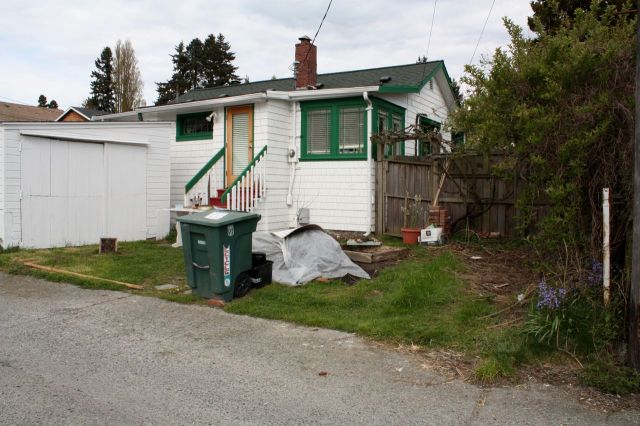
Year 0: Back Yard open to alley
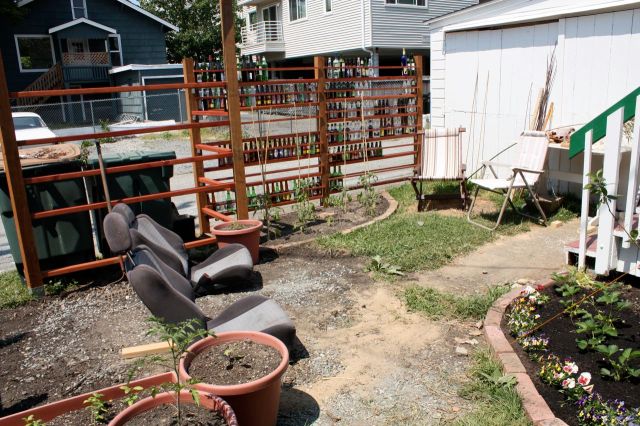
Year 1: Garden beds carved out of the compacted, rubbled back yard; bottle wall taking shape
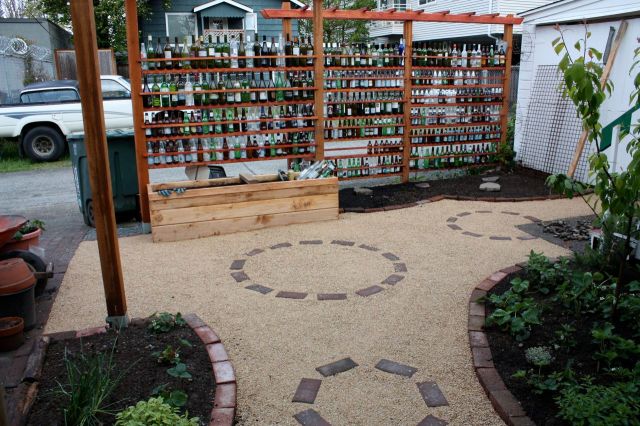
Year 2: Back Yard essentially finished; new beds and no grass

For the garden beds, it was digging up hardpan (mixed with rocks and the aforementioned rusty hardware), sieving it through the 1/2″ hardware cloth of our chicken run door, and mixing in compost.  Transformed, indeed, this bed brought us a rich year of tomatoes followed by a less-rich year of corn and squash.
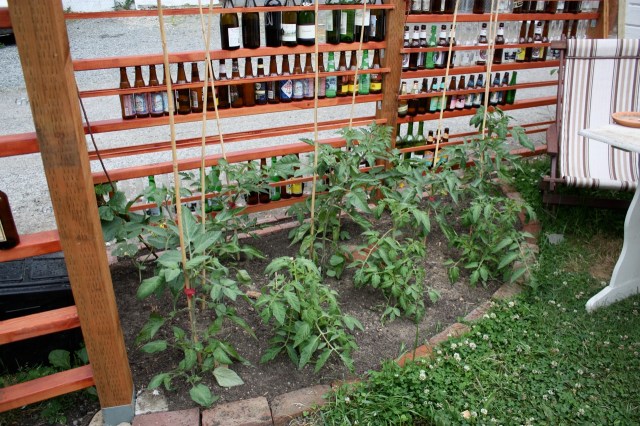
Year 1: Tomatoes (these became 5' tall!)
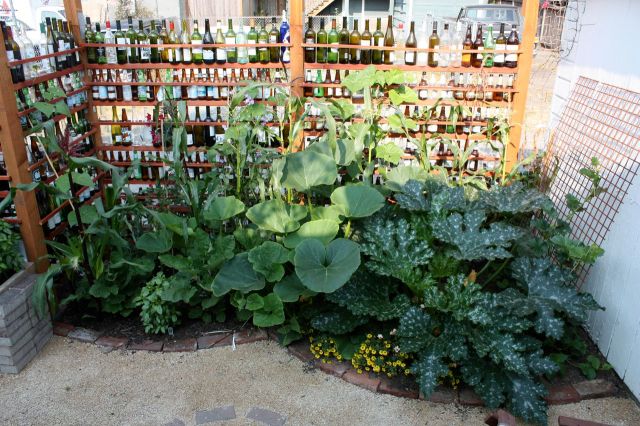
Year 2: Corn, squash, beans

I could have kept planting this bed as-is, with only the addition of compost each year, but this spring I couldn’t put my shovel through it.

What did it need?  Could it really need more compost?  I had added so much in Year 1 and Year 2, the soil was still black.  When I started working it with my hands, I found the clay content was very high and there were still a lot of rocks, despite the 1/2″ sieving from Year 1.  Although clay helps soil retain moisture and nutrients, too much of it can be a problem.  Rocks, too, weigh down the soil and challenge root growth.

At first I was breaking the soil clumps apart with my hands, tossing aside rocks of all sizes.  But this would take me weeks.  Eventually we began a two-step sieving; 1/2″ sieve to remove remaining large rocks and break down the clay clumps, followed by a smaller-gauge sieve to get the remaining rocks.

Clump of clay-rock compacted soil on 1/2" hardware cloth screen
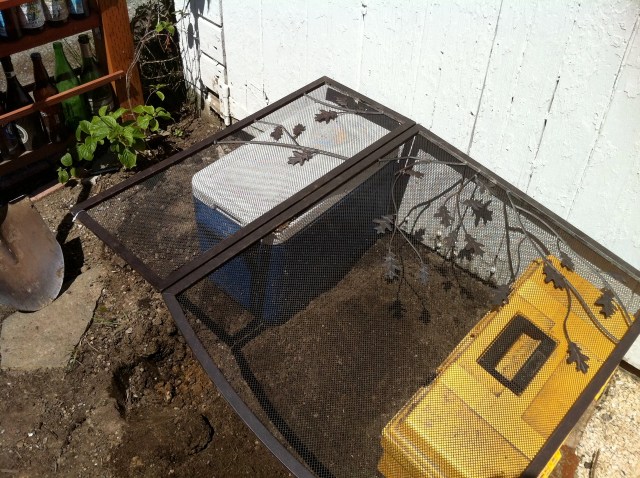
Using the fireplace screen as soil sifter - tedious!

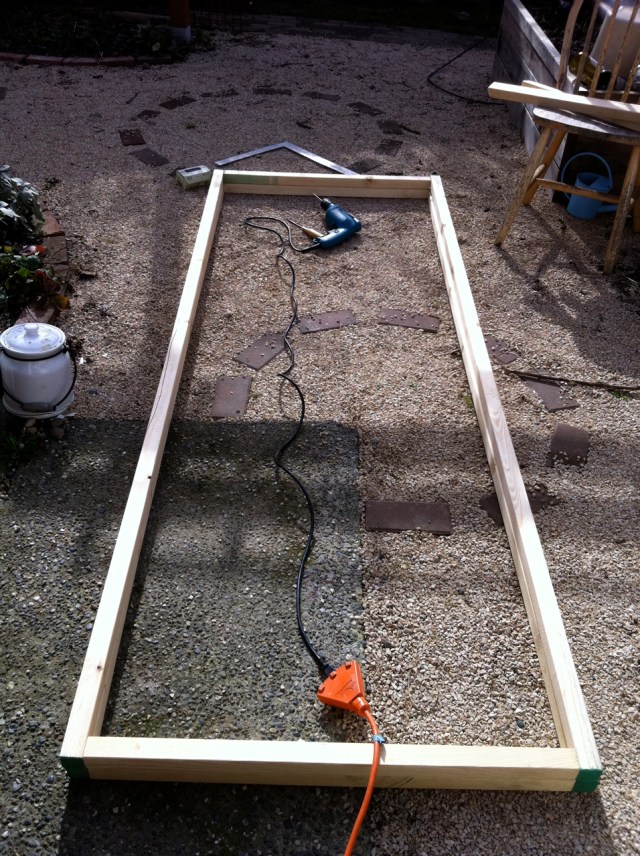
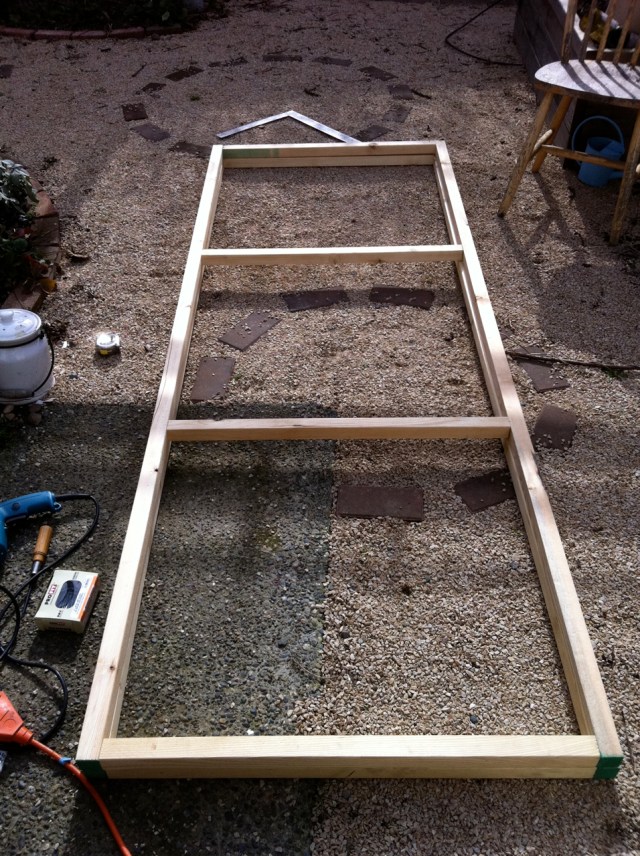
At first we were using the fireplace screen. Creative? Yes, but tedious – the opening was 3/8″. Eventually, I buzzed over the hardware store, bought some 1/4″ hardware cloth, built a frame from leftover 2×3 wood, stapled the cloth to the frame, and voila – the perfect soil sifter.
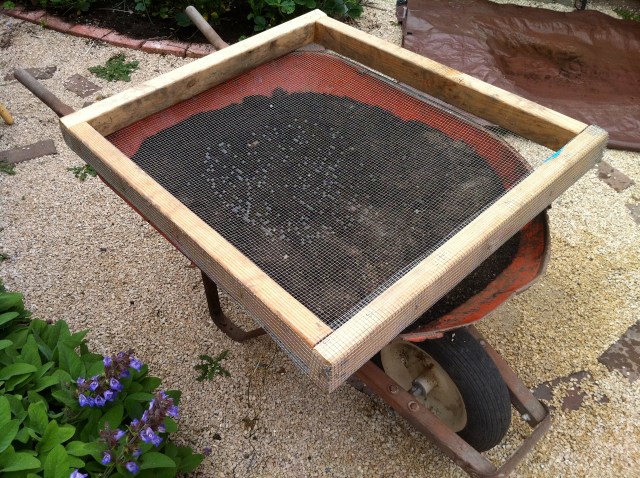
The homemade soil sifter: 1/4" hardware cloth on 2x3 frame
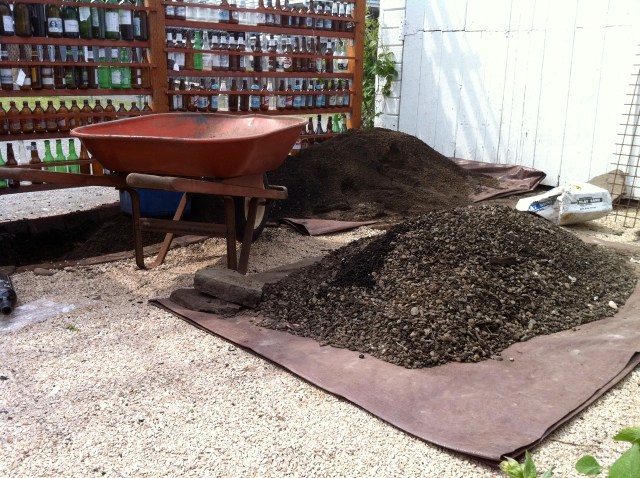
Foreground is pile of rocks sifted from about 1/3 of the bed!

We sifted down 18″, worked in several bags of fine sand, and several wheelbarrows of compost (also sifted; to remove the copious sticks and wood bits).  The result: beautiful, beautiful soil in which bean seeds were delighted to germinate.
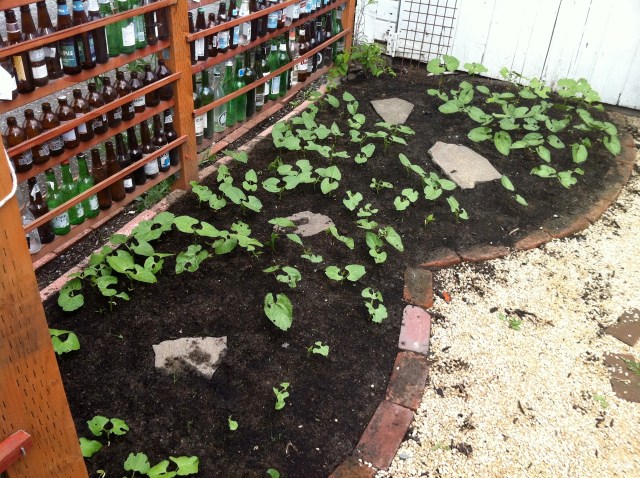
Posted in DIY, soil test, vegetable garden | Leave a comment

Insisting on Tomatoes

My own tomatoes, that is. Not only do I like to grow my own tomatoes for their fresh deliciousness, I like to start heirloom varieties of my choosing from seed to increase the tastiness. I am very fond of Stupice, for its early production and fantastic flavor, Brandywine for its beauty and reliability, and Orange Queen for its impressive colour and large fruits. I also grow a red cherry and yellow teardrop tomato that are reliable producers.

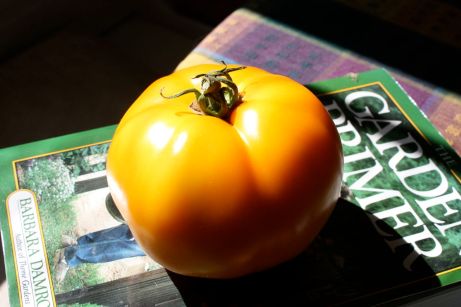
Orange Queen

Last year was a terrible summer for tomatoes in Seattle. Spring never arrived. I really mean this. It was cold and wet right up to summer. Case in point: I suffer spring allergies and in 2010, I didn’t. Most of my starts died and I had to plant whatever varieties I could get a hold of at the last minute. They grew fitfully, suffered diseases. They did ultimately produce tomatoes, but they weren’t ‘all-that’.

This year has also been a cold, wet spring. Add to that, I started my seeds late, outdoors in cold frames. The seeds did germinate and they have grown in to lovely little starts. This week I planted them out.

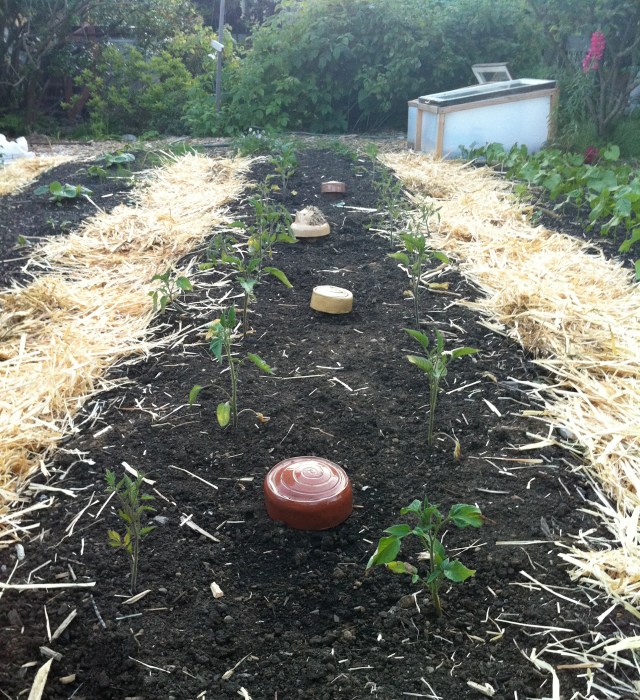
Tomato plants are big drinkers. This year I am using some of my limited olla supply to water my tomato plants. I placed four plants around each olla. I have no control plots this year. I know; not very scientific of me, but it’s a desperate year, what with full-time work and no spring. My measure of success will be relative. I will keep you posted!

Posted in Heirloom, olla, olla irrigation, rain, spring, tomatoes, vegetable starts | Leave a comment

The Big-Little Chicken Wars (or Introducing New Chickens to the Flock)

First our wee chickens were in the fireplace. Then we took them out to the shed. On warmish, sunny days, we started placing them in a pen so they could learn of Sun and Wind and Grass.

Next we placed them in a pen beside the Big Chicken run. With a fence between them, we didn’t think the Big Chickens could do much harm. On their first encounter, the Big Chickens pecked the Little Chickens when they reached into the Big run. After that, the Littles avoided the Bigs, who pretty much left them alone.

Finally, the day came when we thought the Little Chickens were Big Enough. We put them in the coop at dusk. The Littles freaked out. Whenever they flitted close enough, they were pecked by a Big. Greta, the lowest in the Big pecking order, particularly enjoyed herself. Rocky, Head Chicken, just knew it was her job. Baracka, the dreamer & philosopher of the bunch, participated only when necessary.

After a few minutes, the Bigs got bored and went to bed. The Littles eventually followed, holing up beneath the nest box.

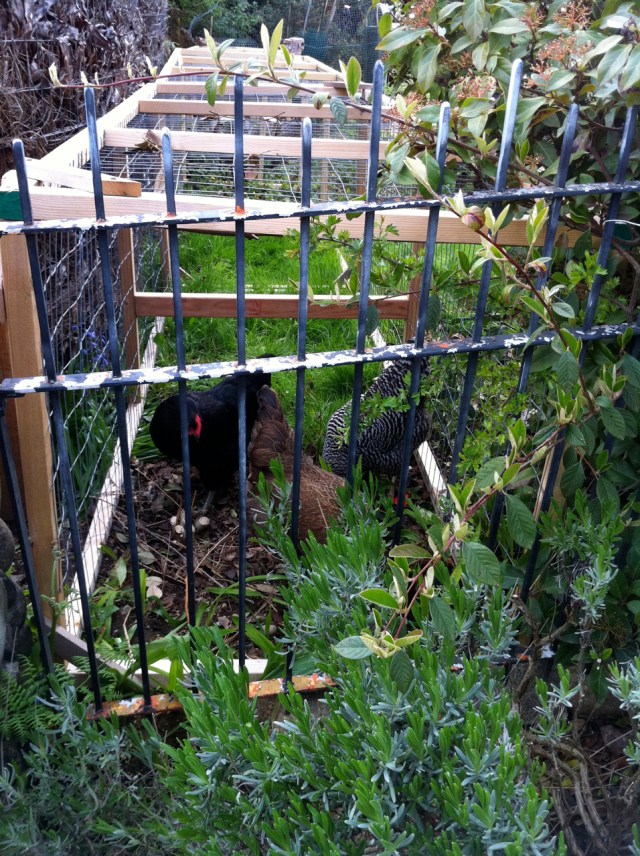
Day 1 of their co-habitation was fairly placid. I spend a lot of time observing them and never saw a Big peck a Little. However, the Littles were anxious to avoid any confrontations and left the area whenever a Big strolled in.  The Littles are still small.  Thrice they escaped the run.  The first time was straight through the gate (4″ gaps).  Duh – fixed that.  The second time, I found a random gap about the same size.  The final time was at the head of the Chicken Tractor Train – where it abuts the front fence with its 3″-spaced wrought iron rails.  I happened to be watching as the Bigs came up the Train.  Freaking out anticipating the inevitable encounter, the Littles squeezed themselves through the fence rails and out onto the sidewalk.  Oops.


This video highlights the majority of interactions. Big arrives on the scene. Littles freak out, freeze, or in this case, freeze and then freak out. Big Chicken goes about her business.

I am suspicious that we have not seen the end of the Big-Little Chicken Wars. I expect the Littles will remain at the bottom of the ladder for now because of their vulnerable size.  But the Littles are still young kids.  They will grow and, with new bodies, they will test the limits of their social hierarchy.  A Matriarch may fall, the rungs of the ladder may be re-ordered.  I will keep you posted.

Posted in baby chickens, chicken coop / run, chickens, nest boxes | 2 Comments

My Chicken Tractor Train

If you don’t care about your yard, chickens are no problem – you let the chickens do their thing, your yard becomes one giant scratch zone (OK, I’m exaggerating, but only a little), and the chickens are happy.

Let’s say, on the other hand, that you have plans for your yard.  Say you like to have pretty plants and grow food and not step on little nutrient-rich land mines when you walk down your steps.  Part of keeping your sanity in raising chickens is to design and implement a Chicken Management Strategy.  Often, as in our case, this will involve adaptive management.

We used to let our chickens roam free.  That first summer, I grew a garden and had to fence it in.  Then I had to put up a taller fence.  Next summer I locked the chickens up in their own yard.  Since then it’s been a battle of cunning and wills – theirs against mine. They may be small and have tiny brains, but there are three of them and they’ve nothing better to do all day than find ways to escape to new scratching territory.

Don’t misunderstand! These chickens are not locked in a pen walking in circles in their own poop. They have some 600 sqft along the side of the yard extending the length of the lot, originally endowed with grassy areas. Why they persist in escaping to the larger yard is a bit beyond me – it’s not like they spend their time chomping the grass they are lacking. They spend most of their time scratching things I don’t want them to scratch – the flower beds, the garden paths, newly planted veggie beds.

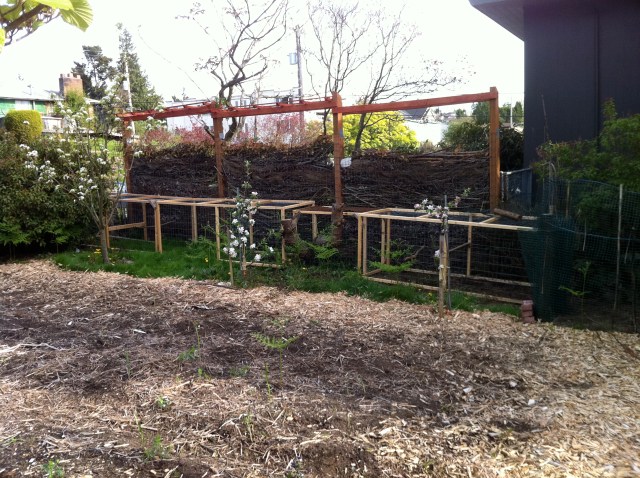
This winter I hatched a new plan. In the front yard, the chickens were finding places to jump at, and then over, the floppy plastic 40-60″ fencing. I reasoned that chickens don’t need all that room over their heads; they don’t use it for anything except jumping over the fence. So rather than build a very tall fence, I decided to enclose them in (potentially movable) chicken tractors.

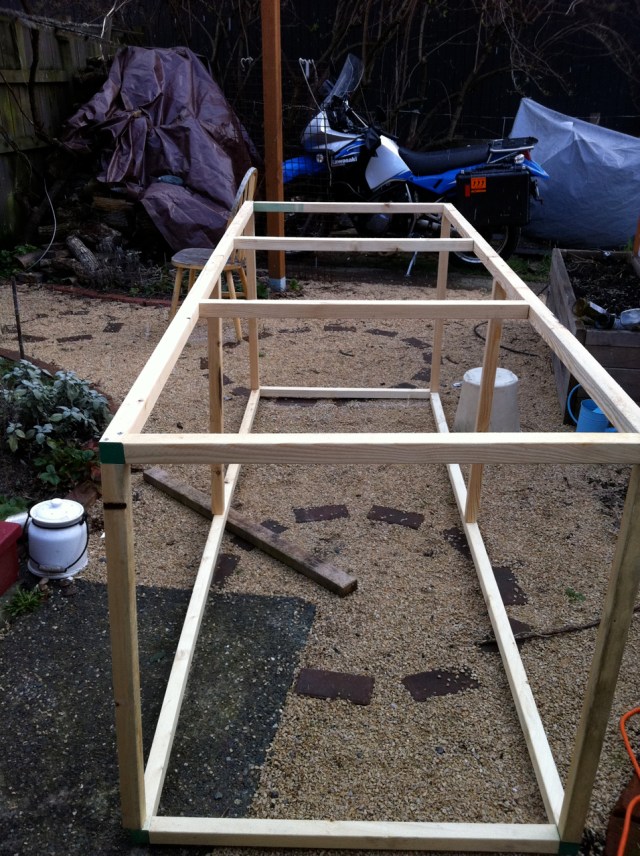
I used cheap 2×2 furling to build a frame:

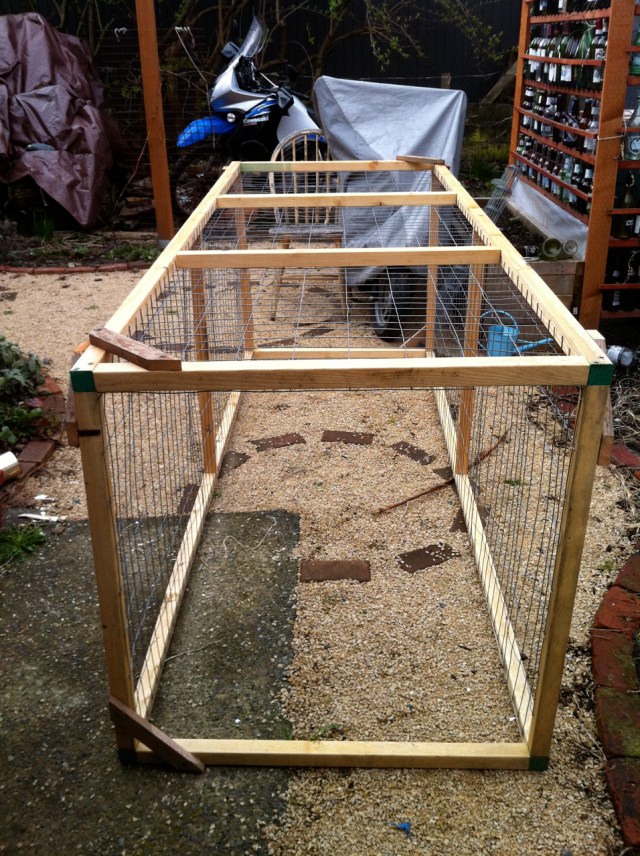
Next I stapled inexpensive welded fencing to the frame. I wanted the chickens totally secured, but with the best visibility:

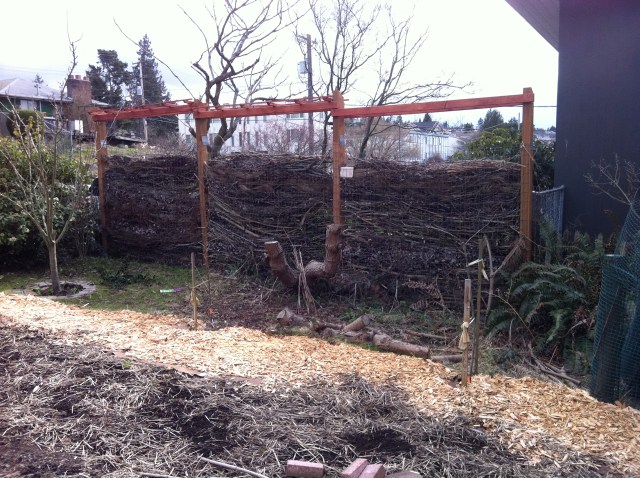
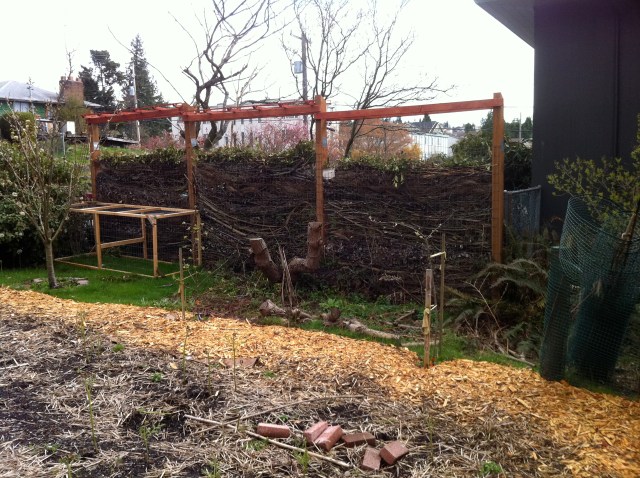
In the yard, I stacked the tractors side-by-each along the composting fence:

Finally, we cleared the bushes along the fence so our neighbours can still visit with the chickens:

The next step is to secure where the old fencing meets the new fencing so I can finally get my garden planted!

Posted in chicken coop / run, chickens, composting fence, DIY | 2 Comments