Best Fruit Fly Remedy


Fruit flies can be a bother at other times of the year, but rarely are they as bad as during harvest season when fresh fruits wait for processing on counters and in boxes around the kitchen.

For a week now, my house has buzzed with fruit flies feasting on tomatoes, apples, and pears from my yard, as well as peaches brought in from eastern Washington. Emptying the compost and removing past-fresh fruit help, but this is a working kitchen. I can’t keep it absolutely free of delectable snacks for the wee pest.

A couple of days ago I conducted a small experiment. I know that fruit flies like red wine, because they often show up in my glass. And I have heard that fruit flies are actually vinegar flies, drawn specifically to the souring of fruit juice rather than the fruit itself. So beside a basket of tomatoes that the fruit flies were enjoying on my counter I set up a glass of red wine and a glass of red wine vinegar. Resulta? NOTHING. Clearly a couple of split tomatoes in the basket were a way more powerful draw than either red wine product.

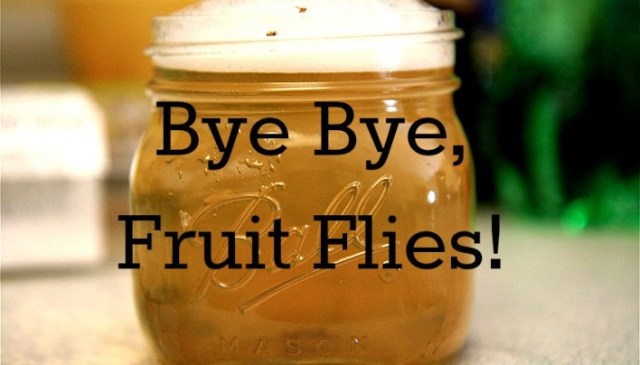
But apparently, all of this fruit is no match for apple cider vinegar. You may have seen this blog post being passed around Facesuck. Lindsey Ferrier at Suburban Turmoil describes using apple cider vinegar, soap, and water to completely remedy a fruit fly infestation. I set it up on my counter yesterday. I replenished the suds once yesterday and once this morning. There are 30 dead fruit flies in the jar and NONE IN MY KITCHEN. Seriously, this works. I thought I had at least 100 buzzing about near the sink, but either there were actually just 30 or the rest were encouraged to find a home elsewhere.

I think what makes this method especially effective is keeping the suds bubbled up to the lip of the jar. I have watched plenty of flies in my outdoor traps and know that it is one thing for them to land on the trap, and another for them to crawl all the way down into it. Same goes with a glass of any fruit fly attractant. With the suds method, as soon as they land on it they are trapped.
Posted in animal behaviour, bugs, Food preservation, fruit, pest control | Tagged , , | 2 Comments

The many signs of rooster

Wee lavender roo

Wee lavender roo

Just like humans, chickens are all the same when they are babies. Boy or girl, they squeak and chirp, and cling to their mom. But chickens grow up quickly.

The definitive sign of a rooster is its ‘co-co-co-rico!’ when it reaches maturity at about 4 months. We’ve been there before. Subtler signs are present earlier than maturity. At 2-3 months, a roo’s feathers start to distinguish themselves from those of the hens with pointy hackle feathers and downturned saddle feathers. But without a lot of experience, you don’t quite believe it. You’re still hoping for a girl, so you wait for that first crow.  After a few roosters, the signs are obvious earlier and earlier. Besides the feathers, squeaking becomes honking as a roo’s voice changes in ‘adolescence’ (2 mo). And if you have more than one rooster, and you’re paying attention, you might see them dance the rooster dance.

The rooster dance starts at about 2 weeks old when baby roos start to play fight. They face off, then fly up at each other, pretending to tear out each others faces with their little clawed feet. I know that sounds awful, but as with any baby animal, it’s actually quite cute. And they are just playing. A little later on, the rooster dance is more serious – a real fight for dominance, and can result in serious injury.

I mid-August, I took our four roos from April and May back to The Bradley Farm where I got the eggs.  Rooster dances followed by honking, and – in the case of the blue orpington – monstrous growth, allowed us to separate the roos from the pullet.  I ended up exchanging the roos for two day-old chicks. I wasn’t planning on getting more chicks, but Calamity Jane was broody again and I thought – what the heck. It’s fun to have babies around.

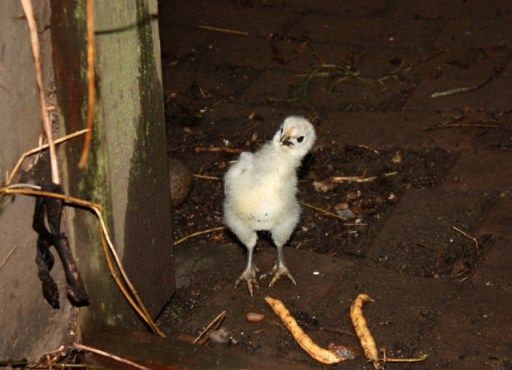
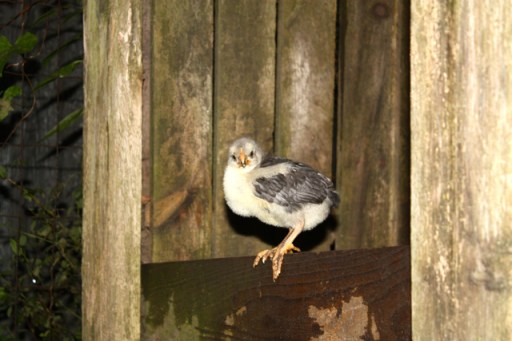
It was the first time I stuck day-old chicks under a broody hen instead of letting her hatch her own (surrogate) clutch. And it worked! Calamity Jane took to the babies and left the nest. There is an adorable blue orpington and a lovely little lavender trailing about after her clucking motheringness.  It has been a pleasure to watch them with the ridiculous hope that these would be girls.  Having not yet seen the dance, I was beginning to assume that of roosters we had one or none.

Today I saw them dance the dance, and my heart sank. Among my two broody hens, we have raised 8 baby chickens this year. In the lot, there was ONE girl. ONE out of EIGHT. That is statistically very far from 50%. Including the previous two years, we have raised 12 straight run chicks.  Ten of them have been roos. What is up with that?

I am not sure what we’ll do if (and I mean when) the girls go broody again next spring. Including the one pullet from Calamity Jane’s April brood, we now have 5 hens. That is a fine number for an urban flock. I suppose that raising roosters is an easy way to get the girls off the nest without increasing the size of our flock, so maybe I will just keep this baby rooster wheel spinning.

Blue Roo

Blue Roo

Calamity Jane with her 'live brood'

Calamity Jane with her ‘live brood’

Posted in animal behaviour, baby chickens, broody hen, chicken behaviour, chickens, education, roosters | 10 Comments

Canned tomatoes or spaghetti sauce?

SpagSauce

Every year I process a dozen or so quarts of tomatoes. Some are used in stews or soups, but most get cooked down into rich spaghetti sauces as needed throughout the year. But we were finding, to my disappointment, that we would still reach for store-bought spaghetti sauce when we needed a quick fix dinner.

So this year I am taking the time to cook large batches of tomatoes into sauces that we will can for quick meals. In the first batch, some olive oil, garlic, and 6 quarts of tomatoes became 2 quarts of thick sauce. I never like the way the store-bought sauces taste when they add the spices for me, so I didn’t add any spices. It won’t take any more time to add ‘fresh’ basil and dried herbs last-minute when we need those quick dinners.

How else do you process your tomatoes?

Posted in Canning, food, harvest, tomatoes | Tagged , | 6 Comments

The Broken Chicken

Snuggling with the Broken Chicken

Snuggling with the Broken Chicken


We raised six baby chicks this year (April & May). It’s looking like 5 of them are roos. When the chicks are a few weeks old, they are small and independent enough to fit through the gate of the chicken yard and range in the garden and human yard. It’s very cute.

When the first chicks were 2 months old, our dog friend Rosie arrived in the yard off-leash. She was ecstatic to find chickens to chase. Chase she did, and she caught the blue-laced red Wyandotte roo. We quickly separated them (Squak! Squak!), and off went the roo, seeming unharmed.

The next day it was raining. Scott watched the babies out in the yard and called to me “Hey, I think the roo is watching the rain fall!”. Sure enough, roo had his head twisted to the side with an eye towards the sky.

The next day it was not raining, but roo was still watching the sky. And walking in circles. Uh oh. Internet searches turned up a condition called ‘wry neck’ – a vitamin E deficiency that can be reversed with gel caps. Except the timing of this wry neck suggested the dog attack was to blame.

The wry neck got worse. Poor roo had trouble eating and drinking; he pecked at an angle and kept missing his target. He could dip his beak in the water, but had to awkwardly swing his head around and back to swallow. Little roo also could not jump onto the roost to sleep with his buddies. I would find him sleeping on the coop floor.

After a few days he seemed to be getting better – I had to really look to see his crooked neck. Unfortunately he was still sleeping on the coop floor. One night we forgot to close the coop door. The next day I couldn’t find the broken chicken. Instead I found all of his feathers.

Some dogs get along great with chickens. In fact, Rosie gets along well with the chickens in the house where she grew up (except for stealing and eating their eggs). But most dogs do have an instinct to chase if not catch if not kill chickens. And unfortunately, chickens aren’t toys. They can’t handle being manipulated by the jaws of dogs. 😦

Posted in animal behaviour, baby chickens, chicken behaviour, predators, roosters | Tagged , | 2 Comments