Broody Hen

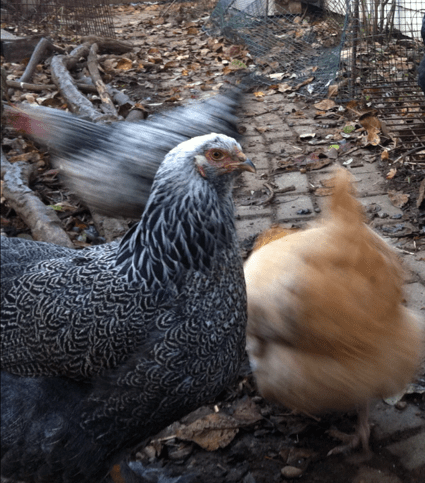
Calamity Jane, our Dark Brahma, went broody in February

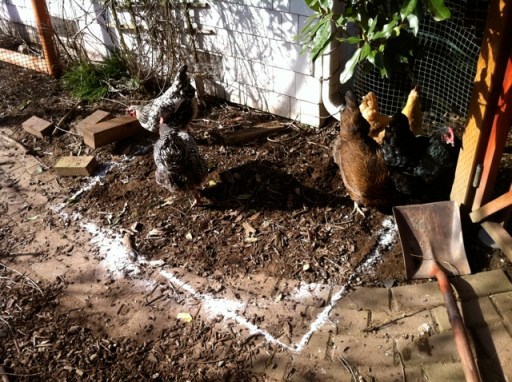
My young hen Calamity Jane sits in the nest box.  She has done very little else for weeks now.  She spends the day in there when the other chickens are out having dirt baths and fighting over the compost pile.  She spends the night in there when the other chickens are sleeping on the roost.  She makes distraught cluck-cluck-cluck sounds when we force her off the nest.  There is no doubt about it – she is broody.

Broodiness is the state of a hen who is attempting to hatch a clutch of eggs.  In a reproductively mature hen, lengthening day can trigger the biochemical changes that lead to broodiness.  So, although chicks can be hatched anytime during the year, nature has arranged the willingness to sit on eggs for 20-odd days to coincide with spring, when the most food would be available to fuzzballs.

When I first realized she was broody, I tried to stop it.  I isolated her – preventing her from accessing the nest box.  I also dunked her in cold water (to lower her body temperature, which elevates in broodiness).  Not only was my bucket a little small (she stoically stood on the bottom while I held her), she was too far gone.  Once the brooding hormones are in full-swing, there is no going back.

Backyard hens don’t all go broody in the spring.  Some can go broody at other times of the year.  And in many the urge is simply never triggered.  I have nothing against natural urges to procreate.  Unfortunately, our hen’s eggs were never going to hatch because we don’t have a rooster to fertilize them.  And a broody hen no longer lays eggs.  As much as we like our fowl, the biggest reason we have chickens is for the eggs.  I don’t mind if one doesn’t carry  her weight for a while – it happens when the hens moult – but, extended broodiness can also kill a hen if she neglects food and water for long enough.

Fertile eggs

Rather than wait to see if she eventually came out of her broodiness, I decided to try letting her hatch some eggs.  If it wasn’t already too late.  There are good signs that she is keeping up her strength; occasionally she stumbles out of the coop of her own free will.  She seeks water.  She scratches pathetically at things that won’t yield food (but I know she has access to feed in the coop).  She drops enormous (I mean ENORMOUS) turds.  She pecks at other chickens like they did something to offend her.  And then she heads back in, uttering that particular cluck-cluck-cluck-cluck under her breath.

Calamity Jane inspects the new eggs

Through the Seattle Farm Co-op listserv, I found a neighbour willing to barter fertile eggs for soap.  I forced CJ off the nest to place the eggs in her brooding spot.  The other chickens were drawn to the coop by my presence and I got to see a fascinating display as CJ defended her nest: growling, bowing low to the ground, spreading her wing and tail feathers, she made a shield that the other chickens decided wasn’t worth investigating further.
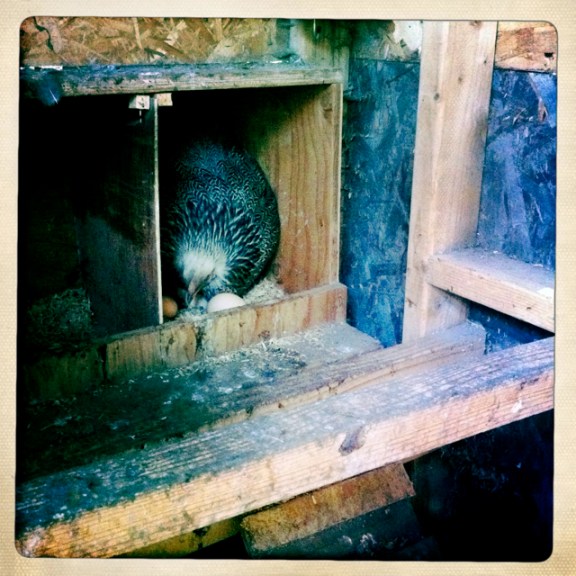
Rearranging the eggs for incubation

CJ inspected the eggs, found them to her liking, and moved back in the box, re-arranging eggs and settling in.  I only hope she can keep it up until the hatch so that she can recover her chicken life!
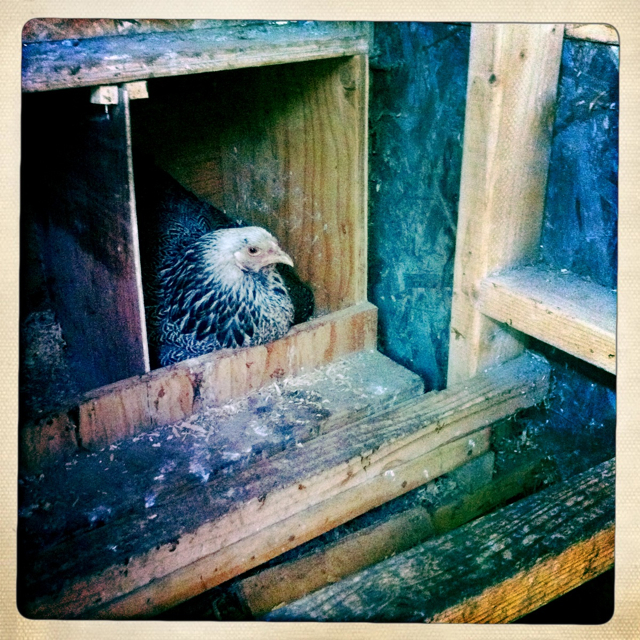
Sitting on eggs - at last

The sad next event

Posted in baby chickens, broody hen, chicken coop / run, chickens, eggs, nest boxes | Tagged , , | 6 Comments

Installing Cisterns

Acquiring Cisterns

I did a lot of calculations before deciding on the what and how-many of our cisterns.  I also sought expert advice.  I met Nikola Davidson, the one-woman show that is Earth Systems Northwest, through a mutual friend.  In addition to numerous emails, Nikola came out for site visits twice to advise.  She ultimately ordered our tanks, arranged their delivery, and provided the plumbing parts.

The tanks are big (cylinders 4′ wide by 6′ tall).  They aren’t heavy, but they are awkward to move.  Our yard is fenced and none of the gates are 4′ wide.  So the tanks had to go up and over; easier in the front (4′ tall) than the back (6′ tall):

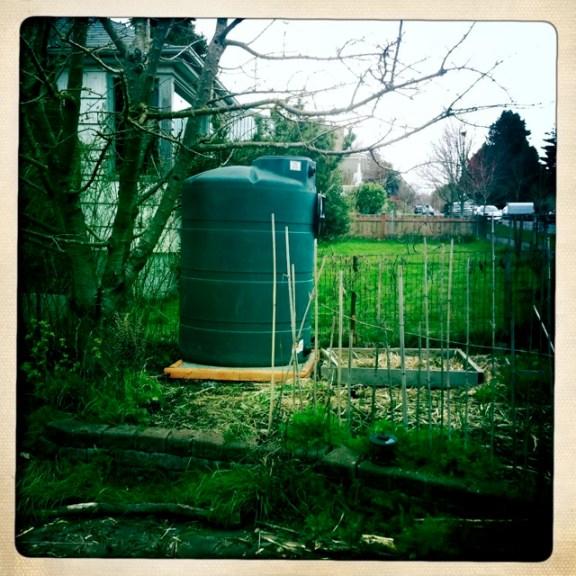
Installing Cisterns

Water is heavy.  At 1 g/mL, each of our 500-gallon cisterns will weigh >4000 pounds when full.  Four tons.   Wow.

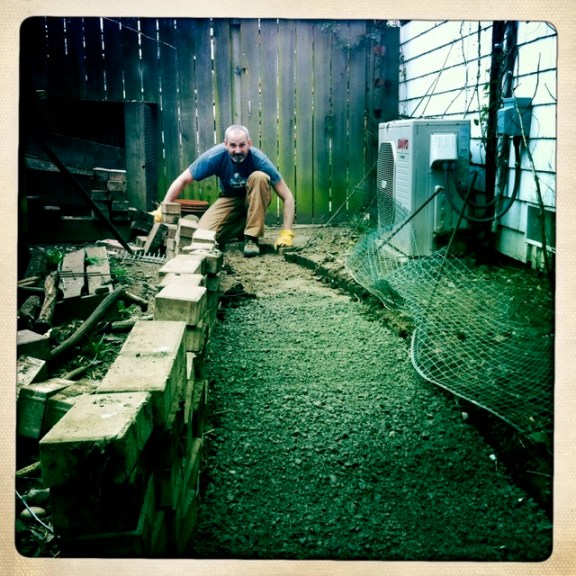
Point being, we needed to create solid bases for our cisterns.  Options include poured concrete pads, cinder blocks, crushed gravel or sand.  We decided on crushed gravel (5/8″ minus) in a wooden frame.

It took a surprising amount of gravel to fill our three 4′ x 4′ frames – about 20 cubic feet (27 cu.ft is 1 ‘yard’).   I had calculated less, but did not factor the compaction of tamping down the gravel.

The first two bases were easy; screw together frames, level, fill with gravel, tamp down, place cistern.  Plumb.

Collection Cistern 1 (pre-plumbing): NE corner of the house

Head Cistern: Collection tanks by house will be pumped here for storage and distribution by gravity to garden.

The third cistern required more time as it was ‘in the way’ of our current path through the chicken yard.  We had toiled considerably to install the brick pathway, but it had issues anyway, being a bit low and a bit narrow.

Future location of Collection Cistern 2 at SE corner of house.

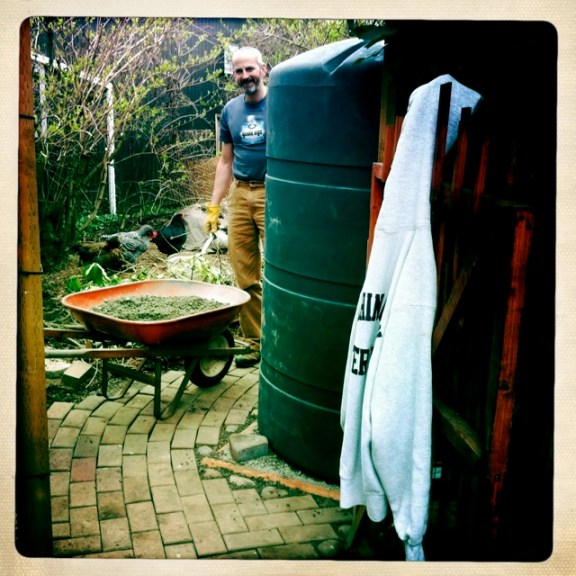
So the one fine day this weekend, up it came.  We built the cistern base into the new, expanded pathway, the chickens had a worm day, working the exposed soil, and everyone was tired but content by sunset.

Re-laying and expanding the brick pathway.

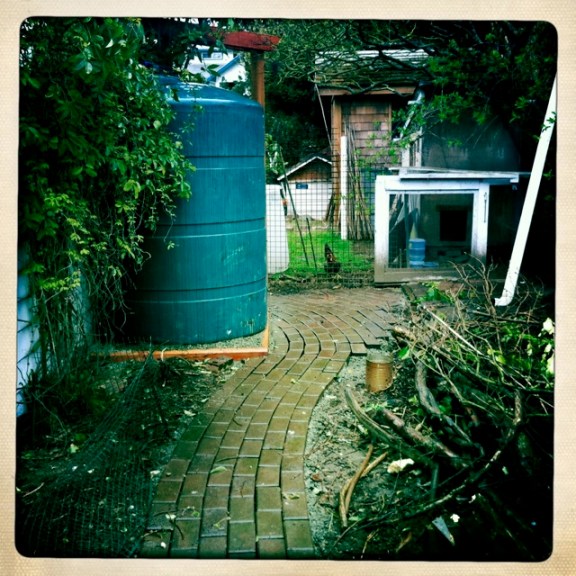
Expanded brick pathway wraps around cistern

Collection Cistern 2 and the new walkway

The Golden Chicken (La Buff) poses by the shiny new installation

It has been a rainy March.  The head tank remains empty, but Cistern 1, installed mid-March now contains 150 gallons.  And Cistern 2 is filling as well.  I will post again when we pump to the head tank!


Posted in DIY, rain, spring, Sustainability, vegetable garden | Tagged , , , | 1 Comment

Holy Shiitake Mushroom Log!

Three years ago we bought shiitake mushroom spawn. The instructions recommended hardwood, specifically oak, as a substrate. Biking around town we found an oak tree chopped into logs on someone’s lawn. We knocked on the door, obtained permission from a renter cranky with his landlord for not cleaning up the mess, and came back to pick up several.

At home, we drilled appropriate sized holes for the plugs, pounded them in with a hammer, and sealed them by pouring melted food-safe wax over the holes. And we waited. And waited. And waited.

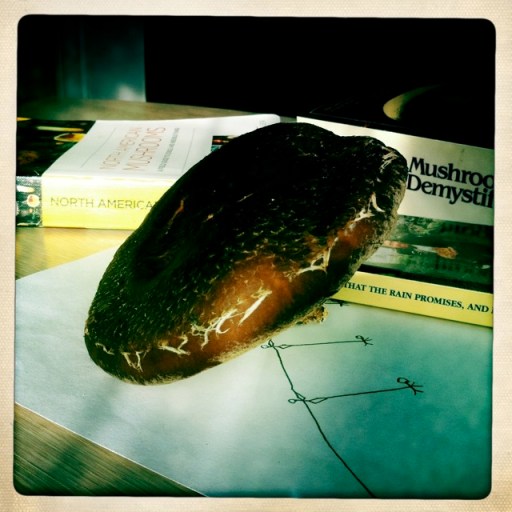
This spring, for the first time, we saw a mushroom ‘flowering’ on one of the logs. It bloomed, and became quite large by the time I finally picked it to ID.

Mushrooms can kill you. Quickly, or, perhaps worse, slowly. But they can also be nutritious and delicious. Although it was highly likely that our mushroom, growing from the wood we inoculated, was shiitake, I wanted to make sure that anything else it could be wasn’t going to kill us.

So out came the ID books. Fortunately I have three – very useful for cross-referencing. Only one of my books includes shiitake, Lentinus edodes, because it is a cultured fungus that grows wild in Asia.

Large (14 cm) mature 'hairy' cap

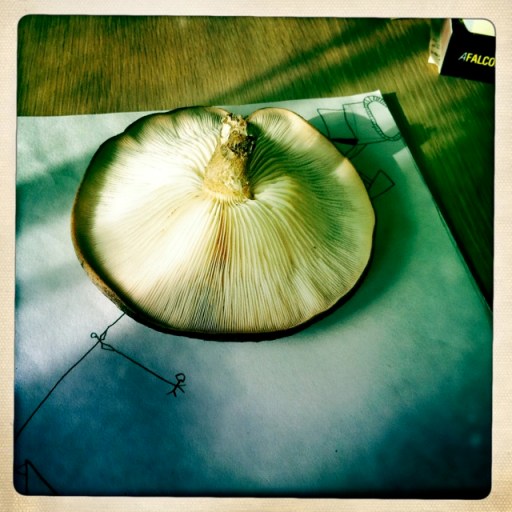
An important identifier is spore colour. For me, it is the hardest part because it requires patience. After an hour, I didn’t see much on my piece of white paper. Either there weren’t any spores, or they were white. After leaving the cap gill-side-down overnight (I wanted to be sure), I had a thick haze of white spores covering the glossy black book I had set the cap upon.

The underside of the alleged shiitake showing adnate gills

I keyed out our mushroom in David Arora’s Mushrooms Demystified – the book that included L. edodes. Check-mark.

How I love dichotomous keys. But they don’t answer every question. If your specimen is not included in a particular key, you will land elsewhere. Which may mean trouble. Luckily, in my other two books, I landed among edible mushrooms; ‘Miscellaneous light-spored gilled mushrooms in Arora’s All That the Rain Promises and More…, and Neolentinus ponderosus and N. lepideus in Falcon’s North American Mushrooms.

Fine, serated lamellae of the gills

So we ate it for breakfast. Sauteed in butter, folded into eggs scrambled with fresh arugula and chives from outdoors, and a bit of leftover chevre.

Cooking up the L. edodes for breakfast

After all that it turns out I am not a fan. Pretty strong taste. There are wild mushrooms that I have loved, so I am not giving up entirely on the effort, but I may give away the next L. edodes that fruits from our log.  Meanwhile I need to become a morel-hunter.  And Agaricus augustus.  And Lepiota rachodes.  Yum.

Scrambled eggs with shiitake, arugula, and chives.

Posted in cooking, DIY, Fungi, Scientific | 4 Comments

Keeping the Hot Tub Hot

This fall I wrote about our insulation woes and our high electric bill.  Although we built storm windows,

“…our electric bill did not go down appreciably. But that is another story…”

This is that other story.

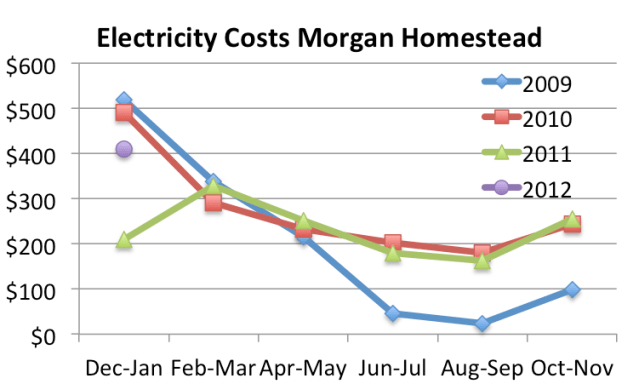
We have lived in this wee house now for 3 years.  Home sweet home.  Practically, this means I now have records for three complete years of electricity use.  Electricity powers everything in our house (except our solar phone chargers!), so not surprisingly, we use more electricity in the winter than summer – twice as much.

I suspected that the hot tub contributed considerably to our electric bill.  The three-year record clearly shows how much the hot tub adds.

In 2009, the heating element burned out.  Twice.  In a row.  It was off-line for most of the summer. It burned out again in Jan-Dec 2011.  Although the timing does not perfectly coincide with our electric bill cycle, it gives us a good idea of how much the hot tub contributes (see graph below).  And the answer is – a lot.

The hot tub accounts for 50% of our winter electricity use and approximately 70% of our summer use.

Discrepancies are periods when the hot tub was offline

Discrepancies among 2009-2011 are periods when the hot tub was offline

Here are the reasons our hot tub is so wasteful:

  • it’s a hot tub; even the most efficient are wasteful
  • wood-barrel instead of high tech synthetic plastics and insulating foams
  • to heat, water leaves the hot tub on exposed plastic pipes, travels up to 4′ to an uninsulated ‘dog-house’ pump station, and returns along other exposed plastic pipes
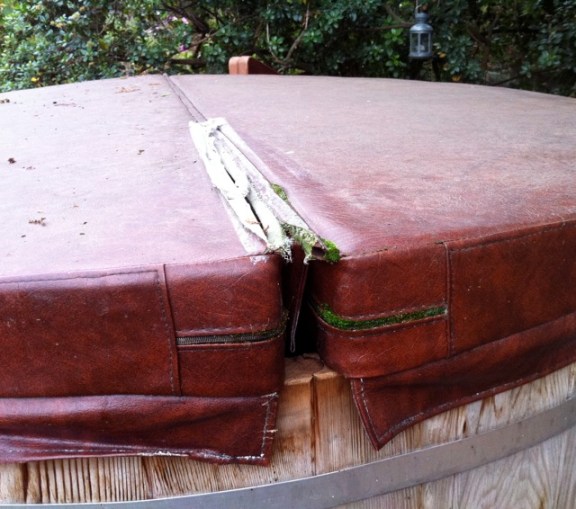
  • hot tub lid was old, and cracked, and grew moss; clearly heat and moisture were escaping

The original hot tub cover showing crack, gap, and moss.

Many of these offenses are easy to fix, such as insulating pipes and the pump house (OK, I still have not finished that project). We also put the hot tub on a schedule; instead of heating 24-7, it now runs for two 4-hr periods, losing about 5-degrees F in the intervening 8 hours. Not sure whether or not that is better.

Finally, we got a new hot tub cover.

Spa Cap floating on the hot tub surface and draped over the lip.

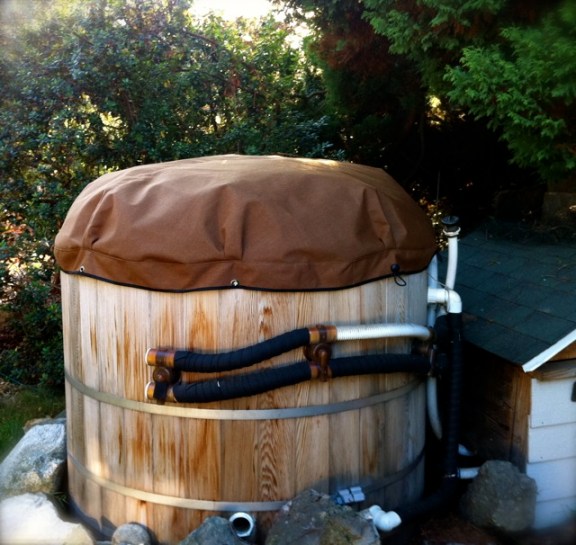
Spa Caps are custom-made in Lynden, WA by real people. Real people you can order from after talking with them on the phone. Seriously. As the Spa Cap website will tell you, they had this great idea to insulate hot tubs with air, instead of foam that tends to saturate and need replacement within 10 years. There are no less than three air baffles in my spa cap. Because the spa cap floats on the water, there is less opportunity for evaporation because heat is not lost to the air layer between the water and the hot tub cover. Nifty.

Despite below-normal temperatures during Dec-Jan 2012, we actually saved electricity compared with previous Dec-Jan periods when the hot tub was working (2009, 2010). We used 23% less kWh than 2010 and 33% less than 2009. Not a lot else changed in the house, so I tentatively call the Spa Cap a success.

We would never have bought a hot tub, but because it was here when we moved in we felt we had to try it. And we love it. Great for warming up on a chilly morning. To relive sore muscles. And to relax after a long, stressful day of work. It is a luxury – one that we will keep working to improve upon.

Posted in energy, update | Tagged , , , , , , , | 3 Comments