Chicken Bumps?

Some of you know our chickens had an Unfortunate Molt a few weeks ago. Someone asked whether that meant they lose all their feathers. Well, yes and no.

Moulting occurs about once a year for most hens, usually in the fall (which seems odd, since it can be chilly by then). How much feather loss occurs varies – more by breed than by individual in my observation (though I am prepared to be wrong about that), and progresses over weeks to months.

Baracka notably loses a chunk of feathers on the back of her neck. Greta is usually a shaggy mess of random loss.  In others you notice the lack of the large primary tail or flight feathers.

This is the first year that Blanca is moulting (Calamity Jane as well). And she is the closest thing to naked chicken I have yet to see. Her back is a shaggy mess, she lost all the feathers down the midline of her chest, and everything from the belly down.

Her naked flesh, now regrowing pin feathers, helps me realize – as little else has – that this is the animal we buy from the grocer – dead, cold, plucked, and cleaned – for eating. Because we have not yet slaughtered any of our hens for eating, it can be easy to forget the connection.
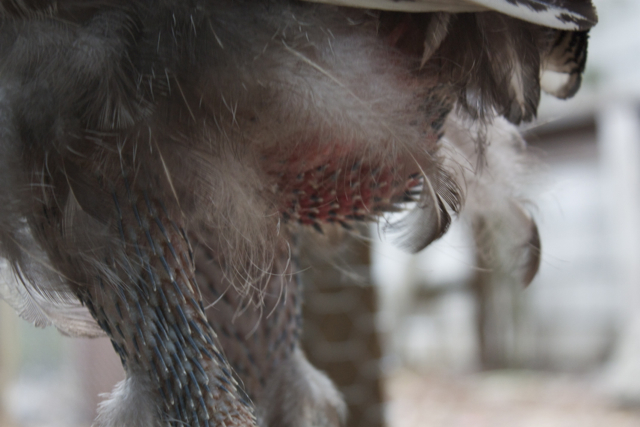
Chicken molt pin feathers

Blanca’s underside – new pin feathers growing after her first molt
Posted in chickens, eggs, update | Tagged | 2 Comments

An Unfortunate Moult

Feather chicken moult

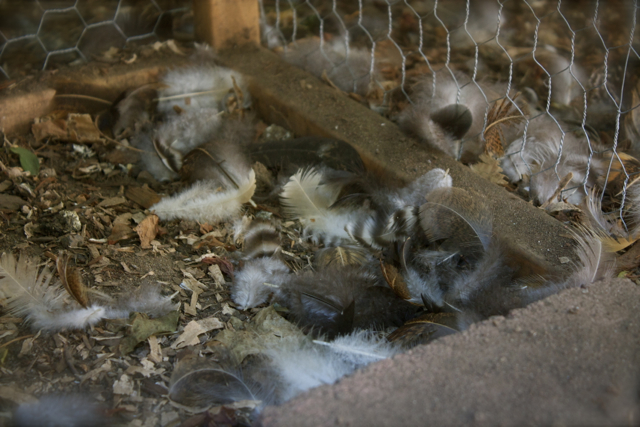
Piles of feathers litter the chicken yard


Two weeks ago we left our hens to fend for themselves for a long weekend. We left the door open and arranged no hensitter. Food was nearly out in the coop, but there was plenty in the compost bins, and several water sources in the yard. Unfortunately, some hen knocked the inner coop door shut and they were all locked in for the weekend – 9 chickens, no food, no water. It was a perfect storm of malchance and neglect.

The hens survived just fine – no one beat anyone up, no one expired. But there are no more eggs. All kinds of stress can cause a hen to stop laying (particularly lack of water), but moulting – when they loose and then regrow feathers – is the worst. Being trapped in the coop without food and water has triggered a moult in our whole flock. There are feathers everywhere and no eggs to be had. And we don’t know how long it will last – a typical moult can take months.

A hard lesson for us in the height of egg season.

Posted in chicken coop / run, chickens, eggs | Tagged , | 2 Comments

Putting Up the Harvest

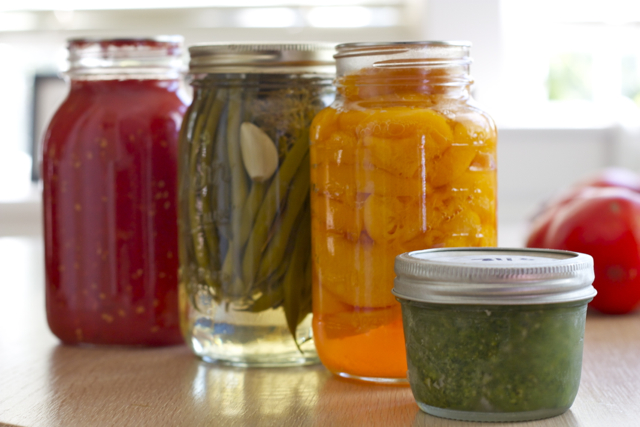
Canned Goods Home Harvest

Tomatoes, Dilly Beans, Peaches, Pesto


As summer wanes, I am buoyed by the harvest – so beautiful and so productive. This week is tomatoes and peaches (purchased in eastern WA), dilly beans, and pesto.

Last year my sweetie gifted me a comprehensive guide to preserving food; ‘Keeping the Harvest’ by Chioffi & Mead. I have a variety of how-tos, but this one is both comprehensive, and very straightforward.

I have always raw-packed my canned fruits, but this year I decided to follow C&M’s recommended method and tried hot-packing my tomatoes and peaches. Turns out hot packing is less work than raw packing. E.g., for tomatoes, the boiling bath processing time drops from 85 min to 40 min. Additionally, by cooking out the air prior to canning, less space is wasted inside each jar, AND fewer jars are needed cause you can cook down the tomatoes into a sauce of your desired consistency. Their method also called for a food mill instead of peeling the tomato skins.

Unfortunately, using a food mill for tomatoes was not a good idea in my case. After quartering the tomatoes and cooking them for an hour, sure the food mill retained the seeds and tomato skins, but it also retained the pulp – not much got through but the juice. After one ladle of this method, I gave up on the food mill and set us to work with chop sticks, picking out the quartered tomato skins. Skinning tomatoes takes a lot of time. I don’t mind tomato seeds in my sauce, so I will probably try the chopstick method again next time.

I am sold on hot packing. The jars sealed successfully (well, 4/5 with the 5th becoming dinner), the tomatoes are further along their way to becoming sauce, and >25 lbs became 5 full jars instead of 8 or 10 filled 50% with tomato, 25% with juice, and 25% with air.

If you have favourite methods or tricks to trade, leave me a note!

Posted in Canning, DIY, Food preservation, fruit, harvest, tomatoes | Tagged , , , | 2 Comments

Chicken Food Fence

As in food, in a fence, for chickens.

The goal of this project is two-fold:
1) Stop the chickens from scratching dirt all over the walkway through their run
2) Provide them with healthy green nibbles that they cannot destroy

Anyone who has read even a few of my chicken posts is probably familiar with my endless battle for order in my hendom. After nearly two years of free-roaming our yard, the hens were restricted to a large, roomy chicken yard; ultimately extending their territory the length of the property with fencing and chicken tractors. While this solution has solved several of our free-roaming hen problems (flies, wasps, poop-mines, exponentially-growing scratch zones), it created a problem as well; nutrition.

Although our hens scratch and peck all day in their 800-sqft enclosure which includes the compost bins and lots of earth, they have pretty much eaten themselves out of fresh greens. And they looooove them some fresh greens! Healthy for them and for us, I bring them grass clippings when I cut the lawn, dandelions when the grow in the gardens, chickweed bouquets from the alley, and plenty of kitchen scraps. But it is never enough.

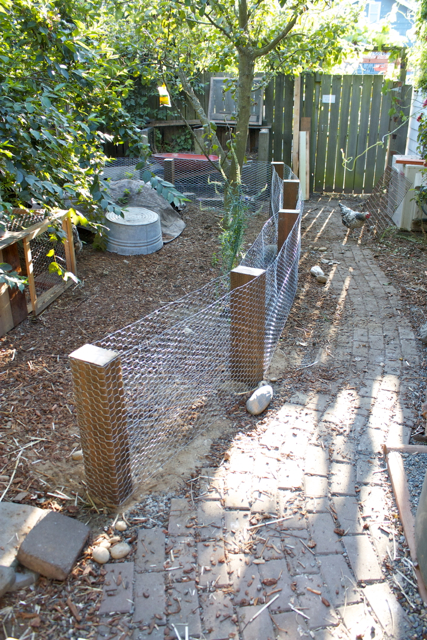
Last year I grew food for them in enclosures. The first crop they loved to death within days of gaining access. I reasoned that forage food might have a chance if it could be nibbled, but not trampled and scratched. The second crop I left inside the enclosure. They nibbled at it by sticking their heads through the 2″ metal mesh. They could reach about 4″ inside the enclosure and that perimeter was completely denuded. A fence would fix the messy path problem, and, with two sides, would provide a large surface area for nibbling on food. A small enough mesh would prevent denuding inside the fence, allowing the plants to regenerate and produce new growth – hopefully keeping up with the appetite of small voracious omnivores with fast metabolism.

Hence was born the chicken food fence. I originally intended to incorporate roosts and arbors, but the space is already busy and I finally caved into just needing to get it done. As with many of my projects, retrofits will surely be made. In the meantime, I will be choosing what forage foods I will plant for my chickens. They know not what awaits them, but I am so excited!

UPDATE on Chicken Food Fence

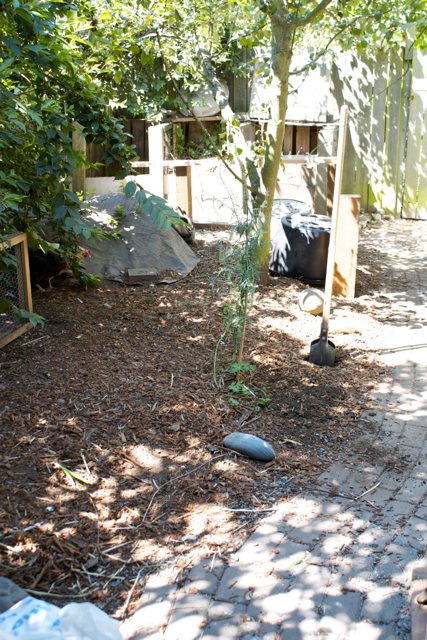
Chicken yard pre-fence


Chicken yard post-fence – decorative roosts to come!

Posted in chicken coop / run, chickens, composting fence, DIY, Health | 5 Comments