Are chemicals people too?

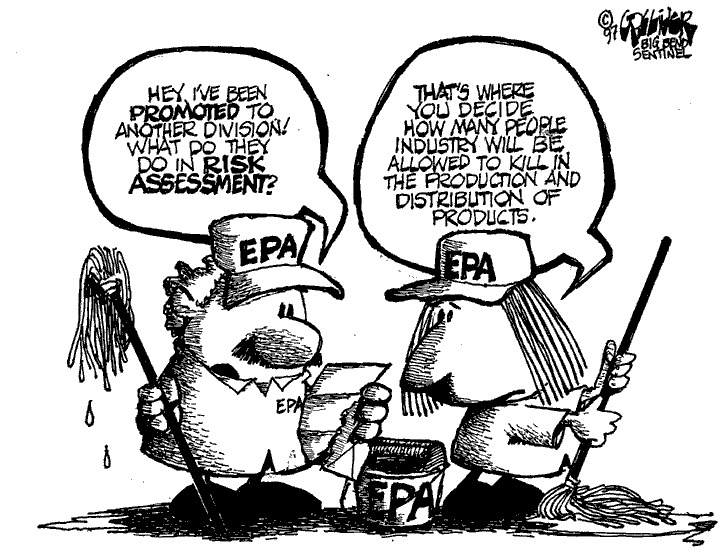
The Presumption of Innocence – ‘innocent until proven guilty’ – makes you think of the noble legal system of many modern nations, right? Does it also make you think about industrial chemicals? If you live in the U.S. or Canada, it should. In the U.S., an industrial chemical is presumed safe unless the U.S. Environmental Protection Agency (EPA) can prove significant harm to humans or wildlife. This places the burden of proof of a chemical’s harm onto the shoulders of Government, aka the public. Although our Toxic Substances Control Act (TSCA; 1976), gives the EPA powerful regulating ability, only five chemicals have ever been regulated in the 30 years of TSCA; PCBs, CFCs in aerosols, asbestos, dioxins, and chromium 6 (remember Erin Brockavich?).

This burden of proof stuff is no joke. To rule against a chemical, the EPA must show the chemical presents an “unreasonable risk”. What is unreasonable? To determine this risk, the EPA must evaluate not only health and environmental effects and exposure, but also the benefits of the chemical, the availability of substitutes, and the economic effects of a rule. (Cause if 100,000 Americans/yr get cancer from it, it might still be ‘worth it’). Whew! And all that with taxpayer money! No wonder very few of the 75,000 chemicals on the TSCA inventory have ever been assessed directly for harm. Wouldn’t it be nice to know the risks associated with all of those chemicals? And might it make more sense for industry to shoulder the substantial costs of chemical risk assessment?

The non-profit Environmental Defense recently published a pretty cool document in conjunction with Pollution Probe of Canada. Not That Innocent: A comparative analysis of Canadian, European Union and United States policies on industrial chemicals does just that, highlighting best practices in chemical control policies, mainly applauding REACH, the new E.U. legislation that came online in June to Register, Evaluate, Authorize and restrict CHemical substances. One of the great aspects of REACH is that the burden of proof is shifted back onto industry ala ‘if you want to make money using that chemical you’ve gotta show us it’s safe’ and the job of Government is just to oversee that process. On the Environmental Defense website I was able to watch & listen to an overview of the report – nice way to learn how we deal with chemicals in the U.S. compared to other modern nations.
Posted in Rants, Scientific | 1 Comment

All I want for Christmas is more Stuff – not.


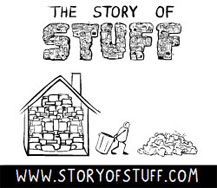
During my lunch break today I indulged in a little reading of my favourite blog: No Impact Man. Colin’s one-year experiment in living zero net impact in Manhattan is over, but he’s still blogging to maintain and encourage dialogue on the subject of sustainable lifestyles. Reading back through December posts, I come across a blog on The Story of Stuff. It is a mini-lecture by Annie Leonard with cartoon animation briefly describing the production of consumer goods. It’s 20 minutes long and you can watch it right on the webpage. I loved it. She highlights the unsustainability of the linear pathway of Natural Resources-to-Landfill. The most obnoxious criticisms I read on Digg were dismissals because she over-simplified the issue. Well, duh, it’s an overview! Every overview is an oversimplification. Besides, the point of introducing a complex issue to a broad and mostly naive audience is to oversimplify! People who want to learn more take it from there. I say, go ahead and have criticisms, have questions, but have an alternative answer. It’s too easy to disagree with an argument and contribute nothing in its place.

I’ve been thinking a lot about ‘Stuff’ as Christmas approaches. We live in a tiny place and are trying to unclutter our lives. Though I own a lot of books and rocks (just ask my boyfriend), I’m not much interested in Stuff. There are the things I need (mostly food), and there are the things I want (climbing gear, art supplies), and then there are the things I am told that I want (new clothes and shoes and the latest gadgets). I avoid a lot of this last category by not watching television or reading magazines and by not visiting shopping meccas but it is a powerful draw, even for someone as marginally involved in the mainstream as myself! What to do? Understand the things that really make you happy. I’m not talking about the 1-day happiness of a new sweater. I’m talking about the enduring happiness of the things that actually make you feel good. Learning a new skill, producing something useful or beautiful, making someone else happy, working at making your dreams a reality. Learn those things about yourself and make the time to work on them. And you’ll start to find that you don’t need as much Stuff as you thought you did and that you’re happier for it! Oversimple? Yes, but not everything in life need be complicated.

Posted in Rants, Scientific, Sustainability | Leave a comment

“Tide is high but I’m holding on…”


So, if global warming were to happen over the duration of one storm event, I’d say I’ve some small taste of the plight of coastal peoples. Last weekend in the Pacific Northwest it turned cold. So cold that Saturday we took the bus instead of riding our bicycles to the Urban Craft Uprising event held downtown at the Seattle Center.

I’d been feeling like snow for days – that feeling, growing up in the Great White North, of the prescience of snow. Well, lo and behold if it wasn’t snowing when we walked out of the craft fair! Great fat flakes drifting wetly to the ground, accumulating as slush on our naive streets and sidewalks. Cold, but what joy they brought! I sang every song I could think of containing the word ‘snow’ while we commuted to and from bus stops.

By Sunday morning the snowflakes had turned to slushgobs – slush fell from the sky, for hours. And by Sunday night gusting winds had brought a new front through and it was rain falling from a warm sky. And it fell and fell and fell, sometimes softer but mostly harder. A record rainfall of 5 inches fell in the heaviest 24 h of the storm. (For context, we get an average of 37 inches of precipitation per year, so Monday alone we got 14% of our annual rainfall!!)

‘All rivers lead to the sea’. Well, in urban environments all storm drains lead to the sea. Storm drains work like this: Water running on pavement falls through the metal grate of the storm drain and flows into a stream/lake/ocean. Pretty simple. In rural areas, the ground is permeable and acts like a sponge. When it rains the ground soaks up water until it is saturated, and then leaks the rainwater to streams over time. In unpaved areas, a big storm will increase water flowing in a river, but the peak flow is delayed depending on how saturated was the ground-sponge, and never reaches the levels it would in urbanized areas.

Pavement makes the ground impermeable to water. When there is a lot of pavement, e.g. urbanized areas like cities, there is no ground-sponge. Rain falls on roofs and pavement, collecting particulates and chemicals, and the cocktail rushes via storm drains into rivers. Streams in urban-impacted areas are ‘flashy’ – all the stormwater rushes in over a short amount of time leading to regular scouring of the stream bed (bye-bye salmon eggs) and high rates of erosion that can make the stream inhospitable to most aquatic life. I know – depressing. But educate and act, I say.

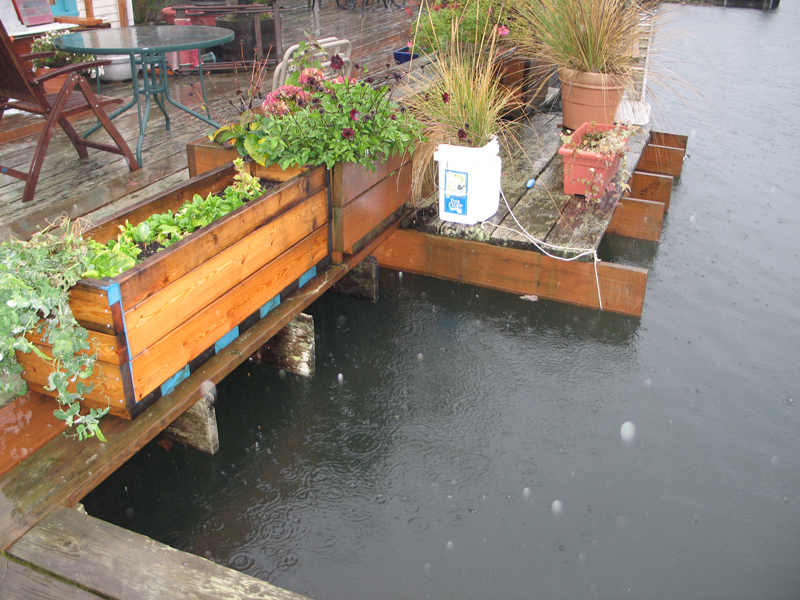
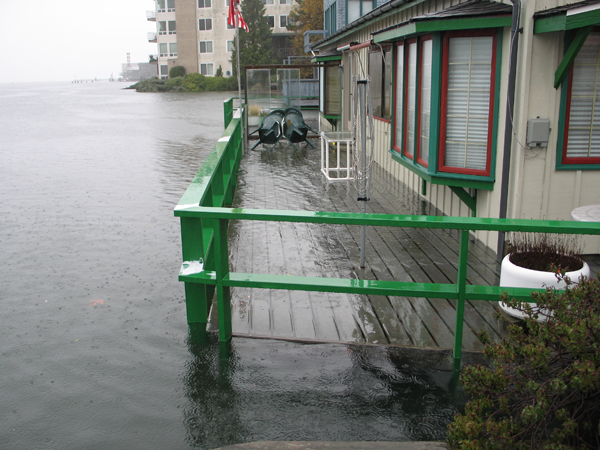
We got to see some of the downstream results of this process during the storm on Tuesday. Those of us living by ‘agua salada’ also contend with tides. As many of you know, our little fisherman’s cottage is perched directly on an old dock under which the tides rise and fall twice-daily. High tide on Tuesday was predicted for 12:17. By noon, the tide had reached the rafters of the dock. Our neighbor Judy’s dock (and by extension her house) was flooded. At its peak, the water had reached 6 inches below the dock and I could hear it lapping at our base boards. Had one of the big ships passed we would have been salty.

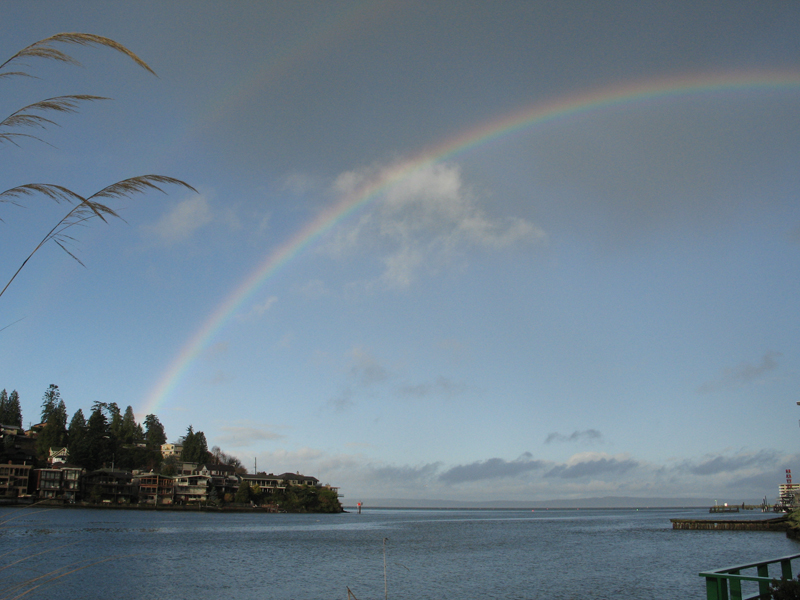
The weather broke in the night and this morning found blue skies and brisk winds. I went out to take a photo of the full rainbow that had formed over the mouth of the ship canal. Standing talking to my neighbor Dan, I glance down and see someone looking up at me from the water, now 4-feet below the dock on my left. It’s a harbor seal! I’ve never seen one so close up – it’s sleek grey head is streaked with dark marks. It’s obsidian eyes stare back at mine, nostrils opening and closing. It’s hard to tell if he is considering me in the way that I am considering him or if he is merely confused from all the turbidity and contaminants polluting his usually pristine home. After nearly a minute, he slips back down into the murk of the storm-stirred brackish water. Normally, this water is almost painfully clear, each pebble eerily outlined when the sweet and salty waters are mixing. But today, when the seal melts back into the water, he is gone.

Posted in Scientific, winter | 2 Comments

“Our world is so full of beautiful things…”


“Our world is so full of beautiful things: Fruit and ideas, and woman and banjo music, and onion with purple skins.” ~Edward Abbey in ‘Every River I Touch Turns to Heartbreak’.

And potatoes with purple skins and purple flesh as well!

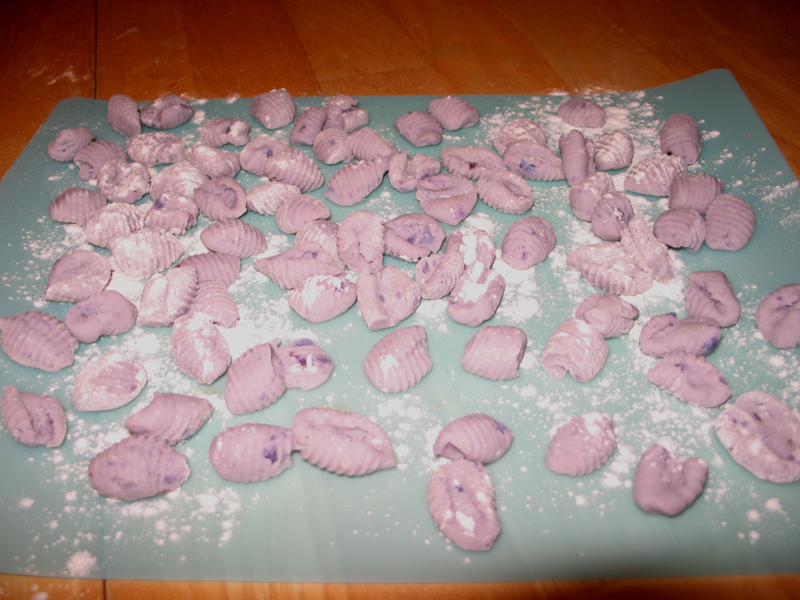
Yesterday was Sunday and so I made time amid my pleasant fire-side reading to bundle up for the cold and the drizzle and bike down to the Ballard Farmers Market. It had rained earlier so my butt was wet by the time I reached the market but a dry spell allowed me the leisure of parking my bike and strolling the market, warmed by my ride over. We are lucky because our local market runs year-round, bringing us local produce, meat, and dairy even on rainy Sundays in winter! God bless the Pacific Northwest. About one quarter of the stands are craftsfolk – I saw felted wool hats in beautiful purples, ochres and blues, hand-crafted soaps and herbal products, seed jewelry, and knitted children’s toys. Another quarter of the stands feature yummy healthy ‘fast’ foods – chard quesadillas, spinach and cheese crepes, and local pastries. The other half of the stands are what I come for – food! There was a stand for local seafood, local fish, one for a farm selling meat and eggs, and many more offering what I have been missing this week – fruits and veggies. I bought several Anjou pears for the apple-pear-cranberry pie I’ll bring to Thanksgiving dinner, some staples of green onions and carrots, a gorgeous head of purple kale, and a pound of beautiful little purple potatoes (see photo above!).

For the first time I stopped at the stall featuring locally foraged fungi. All he had fresh Sunday were saffron milkcaps so I bought several, dinner beginning to form in my head: purple potato gnocchi with wild mushroom cream sauce, purple kale with bacon and onion, offset with gorgeous orange yams. Too bad I didn’t take my own photo cause the mushrooms were this lovely orangey brown, stained green where they had been bruised.

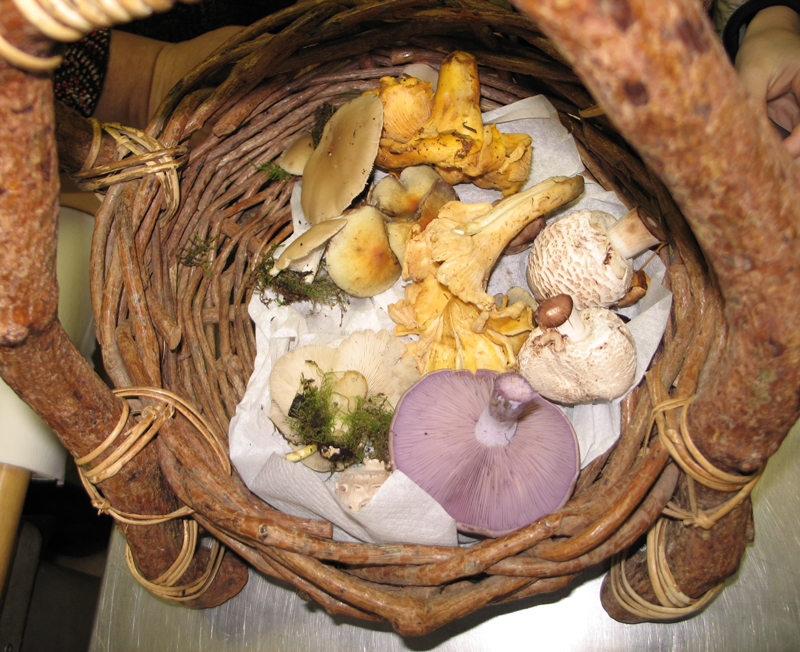
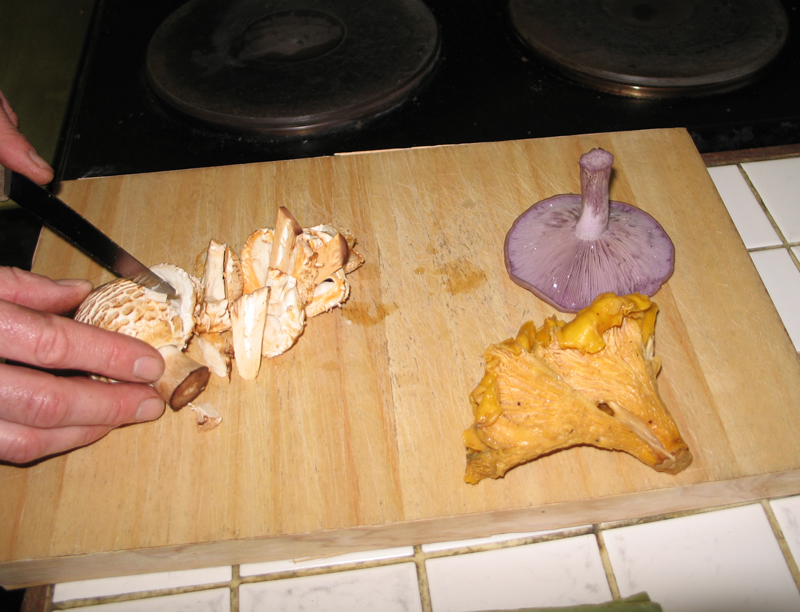
We’ve been getting into wild mushrooms. I highly recommend David Arora’s ‘All that the rain promises and more‘ for an entertaining pocket book on the subject of mushroom ID. Last weekend I mentioned we went mushrooming at Camp Long. We collected a variety of common edible mushrooms including angel wings and oyster mushrooms, blewit, chanterelle, woodlover, and our favourite – the shaggy parasol.

Here are some pics from that afternoon:

Can’t wait to get back out into the woods and find more pretty yummies!

Posted in cooking, Fungi | 3 Comments