“Commercial shampoo and conditioner are like heroin for your hair” – Umbra
They call it ‘no ‘poo’. No ‘poo is washing your hair without commercial shampoos and conditioners. Yes, an alternative to shampoo is soap. No, that is not what I’m talking about.
Have you ever read your bottle of shampoo? Here is one:
Water, ammonium laureth sulfate, Ammonium Lauryl Sulfate, Glycol Distearate, Cocamide MEA, Dimethicone, Cetyl Alciohol, Fragrance, Sodium Citrate, Polymethacrylamidopropyltrimonium Chloride, Sodium Benzoate, PEG-14M, Dihydrogenated Tallowamidoethyl Hydroxyethylmonium Methosulfate, Disodium EDTA, Sodium Choride, Citric Acid, Methylchloroisothiazolinone, Methylisothiozolinone, Ammonium Xylenesulfonate, D&C Yellow No. 10, FD&C Blue No. 1
Whew! Go ahead, read them out loud. I dare you not to giggle. I have a chemistry background and even I found myself laughing as this or that name went on & on.
Even ‘natural’ shampoos and conditioners can have a lot of ingredients, although, granted, many of them are oils or extracts of plants. I have tried various bulk products from the local natural foods store, but have been dissatisfied.

My issues with shampoos are several:
1) Nasty and/or unnecessary ingredients that I don’t want polluting Puget Sound
2) Bottles bottles bottles. Sure you can ‘recycle’ them, but why have to?
3) Build up on hair after very short time
4) Best ones are $$$$
I knew there were alternatives, so when I saw this video on Grist, I jumped at the chance to try something really different.
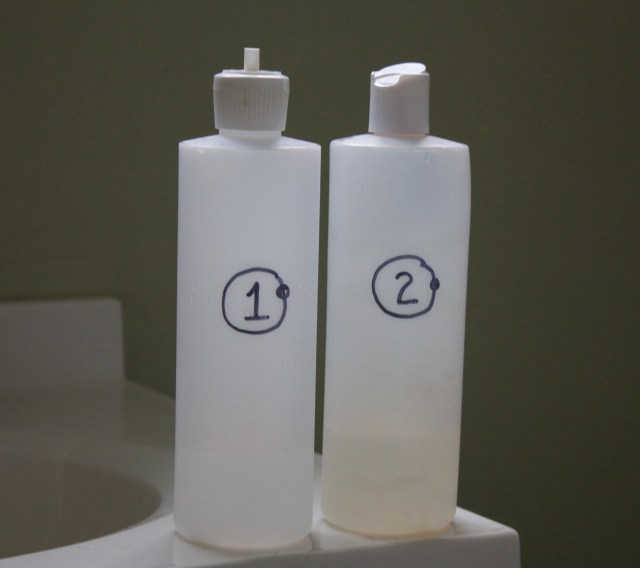
In the photo above, I am using two 16 oz bottles (what I had on hand).
Bottle 1 (‘shampoo’) = 2 c water + 2 T baking soda
Bottle 1 (‘conditioner’) = 2 c water + 2 T apple cider vinegar
Seriously. Watch the video for explanation. Here I want here to summarize my experience with this regimen.
1) Technique. My first few uses were awkward because unlike commercial shampoo, these solutions are not viscous. At first I tried using the same technique as shampoo: pour into hand, apply to hair. Because these solutions are just amended water, you can imagine that not very much of it made it to my head. Instead, I have taken to applying the nozzle directly to my head. Tilt head, liberally pour, scrub. Apply to new spot on head, pour, scrub. You might think this takes a lot of time, but it really depends on how much hair you have. With commercial shampoo I often had to wash my hair twice in a row. That took time, too.
2) It is very important to use enough of each. You need to use enough baking soda solution to clean your hair and enough vinegar solution to rinse out the baking soda. At first I wasn’t using enough vinegar to neutralize the baking soda. Think of baking soda water as salty. Think of your hair after you’ve been in the ocean. Kinda ‘dirty dog’, no? Sorta sticky and unmanageable? Liberal use of the vinegar wash fixes that.
2) I have a lot of thick hair, so I refill these bottles after about 4 hair washings.
3) While in the shower I wash my face with #1 followed by #2. Squeeky clean.
4) When I wash my hair, it is clean clean clean. Light and clean. I love it. It makes me wonder why more people don’t know about this very inexpensive alternative to hair heroin. Plus, I appreciate that I’m not contributing to polluting our waterways. We don’t even know the ways in which these complex ingredients affect aquatic biota. And do not presume that these chemicals will magically disappear in the wastewater treatment processes. All sorts of pharmaceuticals make their way through ww-treatment and into fishes. Here is a recent example.
4) Caveats and considerations. Some people say your hair has to ‘detox’ on this regimen for a few weeks during which time your hair is more oily or what-not. I don’t remember this, but it may have been true. I have heard people say this method does not work well if you use ‘hard’ water. Hard water has a lot of minerals in it that would bind up the bicarbonate of the baking soda and could also neutralize the vinegar. You’d either have to use more of each in the same amount of water, or use distilled water instead of tap water. FYI: Water hardness maps of USA and Canada.
You might think I’m funny-lookin’, but I love my hair off heroin.

Disclaimer: This hair-do has benefited from absolutely no primping. I simply washed it, towel-dried it, then went about my day. My point is that I recognize it could look a lot better with some styling.





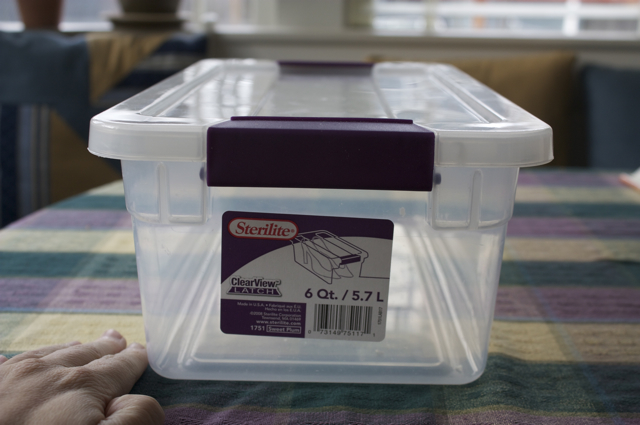 The authors recommend making what is essentially a quadruple batch at a time in a 5-qt container without a tight-fitting lid. A round container is probably preferable so you could mix and store in the same container.
 Because my container is obviously ill-suited to mixing, I mix the dough in this round bowl then store it in the plastic one.
 The recipe instructs to first mix together the water, salt, and yeast. I know salt can kill yeast, so to be extra careful, I dissolved the salt (1.5 T) in the water (3 c lukewarm) first, then stir in the yeast (1.5 T).
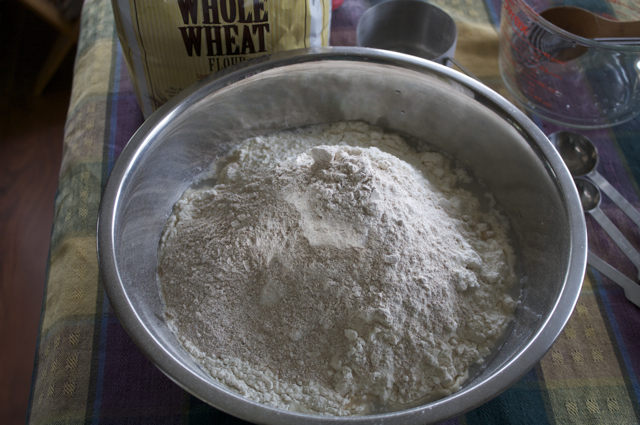 Next is the flour. For this recipe, it is 5.5 cups of AP white flour and 1 c whole wheat bread flour.
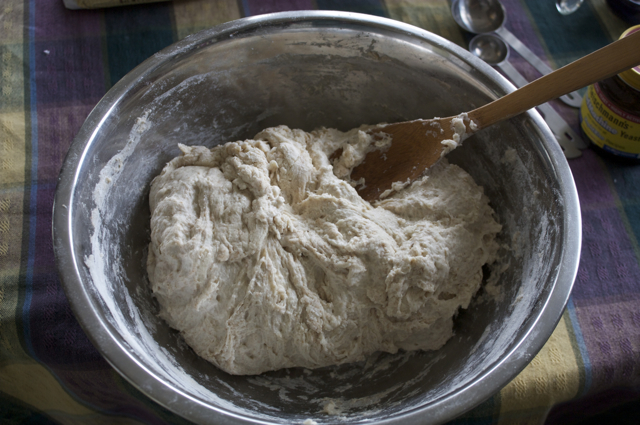 Once mixed in, the dough is wet and sticky.
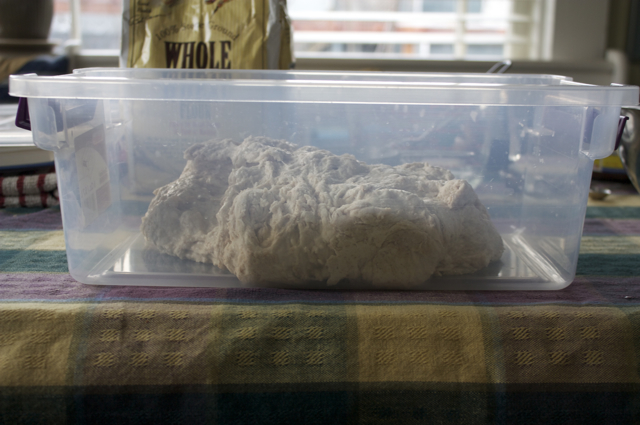 This particular dough may be a little too dry, because it should conform to the shape of the container.
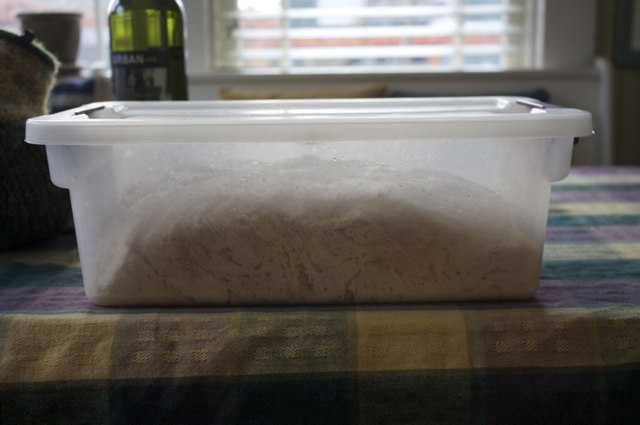 After a night in the fridge, the dough has already risen significantly and could be used to bake bread.
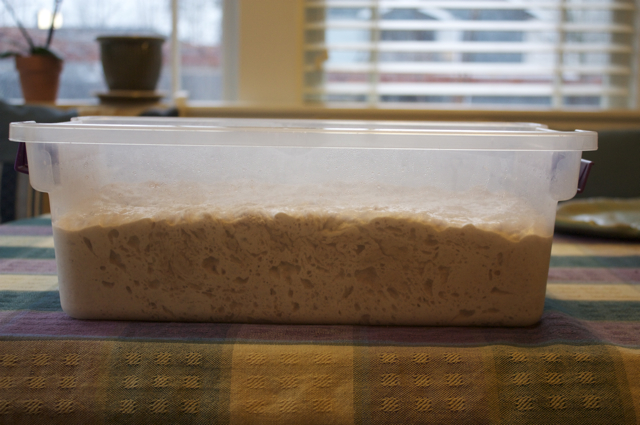 24 hours after mixing the dough, I am ready to bake. You can see that the dough has risen even further in the 8 hours since I last looked at it.
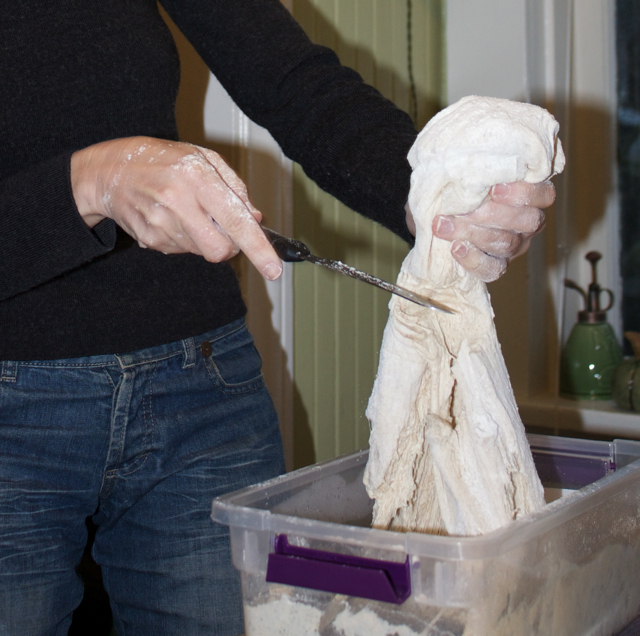 After sprinkling the wet dough surface with flour, I grab a ‘grapefruit-sized’ ball of dough and cut it from the remainder. NB: those of us with small hands often do not attain the desired ‘grapefruit’ amount of dough and must either use two hands or settle for smaller loaves.
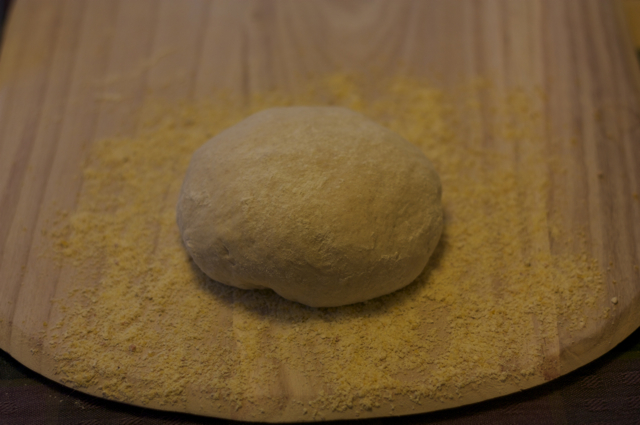 The dough is shaped by stretching the surface tight, collecting the ends under the ‘boule’, in this case. Cornmeal keeps the ball from sticking to the wooden peel.
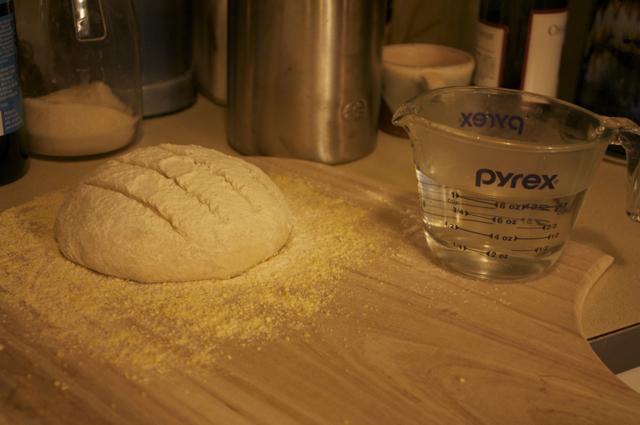 Just prior to baking, dust the surface with flour and cut 1/4″ indentations with a serrated knife. This is an important step allowing the loaf to successfully rise (i.e not explode). As the dough is slid onto the hot baking stone (450F), 1 cup of water is poured into a pan beneath the stone. The steam paradoxically allows the crust to crisp.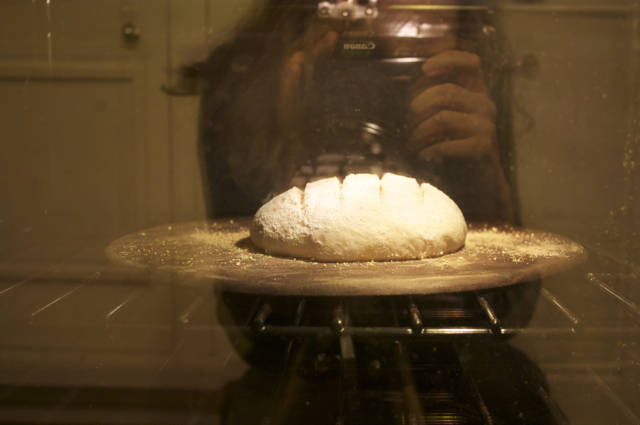
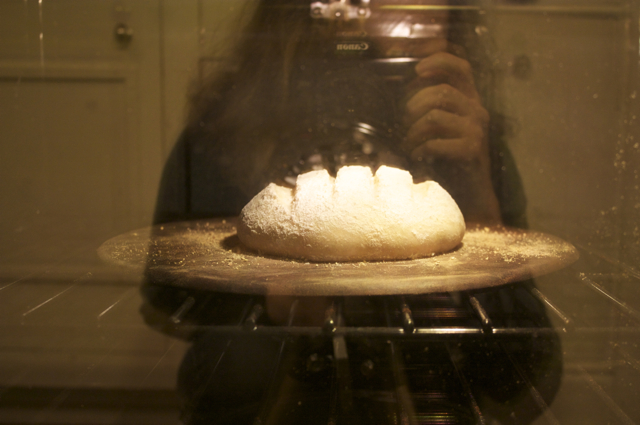
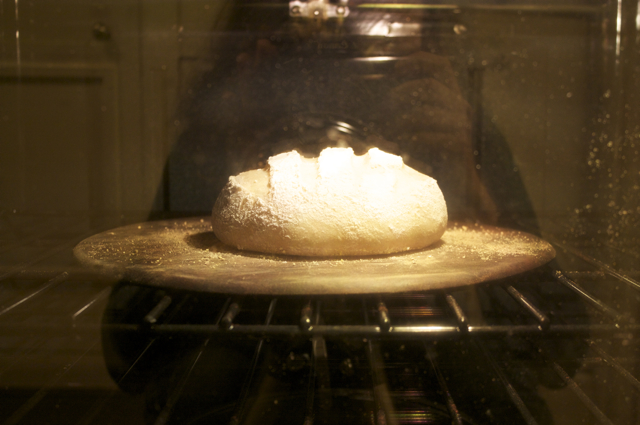
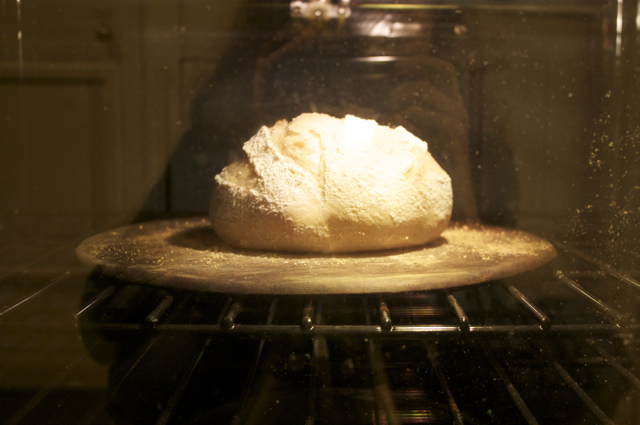
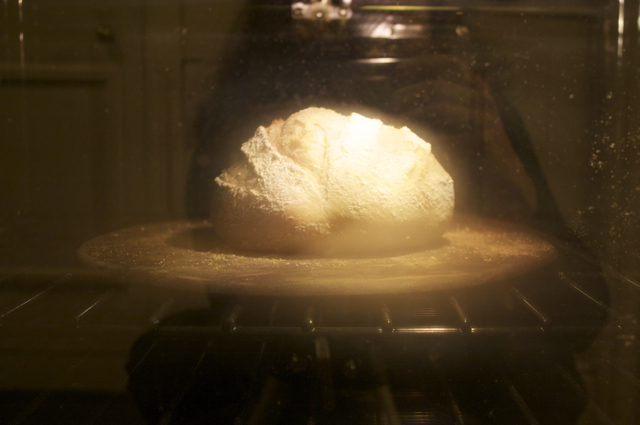
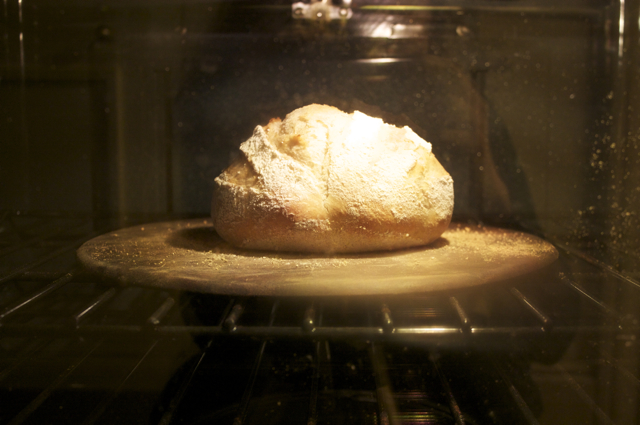
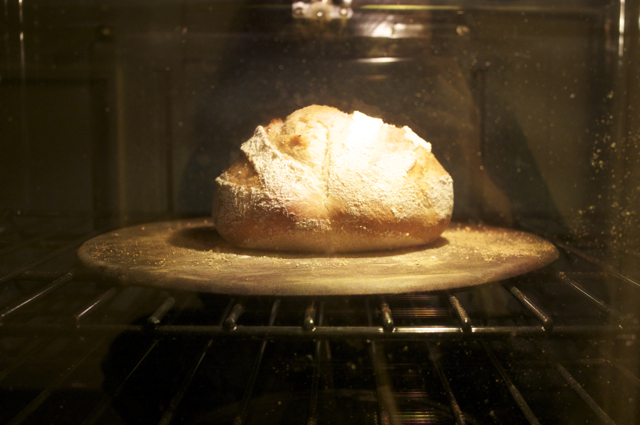 35-40 min later, the loaf is dark and crisp, with delightfully spongy crumb.
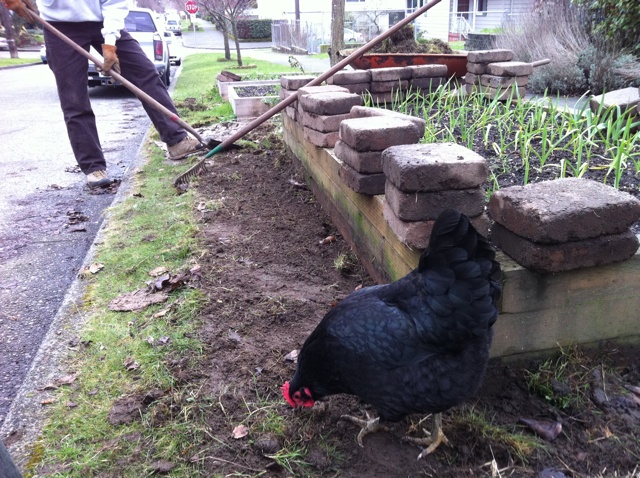 Baracka ‘helping’ to level the soil
 While we worked, we babysat the chickens. I was curious: How far would they roam? Would they walk onto the street? I was nervous that a leash-free dog would attack them. Resulta? They ranged one house up and one house down – pretty much sticking to where they could see us. When a family came by with a dog (on a leash, but still), I gently herded the chickens and they waddled back into the yard. Simple.
 Sustainable Scientist
