Starting with Cisterns

I have been dreaming of a sustainable water collection system since long before we moved onto our little urban farmlet.  I dreamed and schemed, but could not get far – the project was too big for my brain.  An all-or-nothing girl, my much more reasonable boyfriend has at last convinced me that incremental & adaptive will ultimately get this project finished.

So I am starting with a few cisterns.  But what what size? How many? Where?  Our house is tiny (800 sq.ft), with lots of little roofs.  If your house is large you can harvest rainwater from just one downspout into one large cistern, plumb it to your garden and you are finished.  Our many tiny roofs required more planning.

Collecting runoff for later use is a volumetric balance between water quantity and timing.  Although ‘it rains a lot in Seattle’, our rain is seasonal (dry summer).  In climates with regular rainfall throughout the year, you don’t need to store much water because your cistern will fill again soon.  The longer your dry spells, the larger the cistern you will need to tide you over until it rains again.

Here is what I did:

I calculated the aerial surface area of each roof section, and then entered my native habitat: Spreadsheetlandia.  Using formulas found online, I calculated the volume of rain that I could expect to collect from each roof section each month.

inches rain x 0.623 = gallons/SQFT x roof SQFT x 0.9 efficiency = volume that month

OK, that’s how much water I can collect.  How much water do I need?

Our bimonthly water bill tells me we use approximately 20,200 gallons of water per year.  That is a lot of water.  Our wee house does not generate that much runoff water in an entire year.  But we are starting small – just water for the garden for now.  The difference in water use between summer and winter tells me how much water I use for the garden; about 5200 gallons, mostly between June and October.  I calculated that I don’t have enough roof area to get away with just one cistern – I will need several.
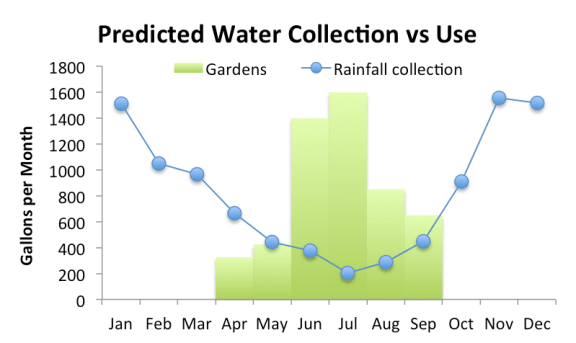
Rain collection is from the NE, SE, and SW corners of the house, assuming 90% efficiency.

Our tiny house is squished into the NW corner of our 6000 SQFT property.  Ideally we’d put cisterns on the N side of the house where we can’t grow food and the cisterns would not be exposed to sunlight.  But ideal spaces were next to none.  Most spaces either would not fit a cistern, would take over valuable garden or patio space, or would be very unsightly.  Finally, my yardens are mostly uphill from the house.  I was hoping to gravity feed my crops, but clearly something was going to have to give.

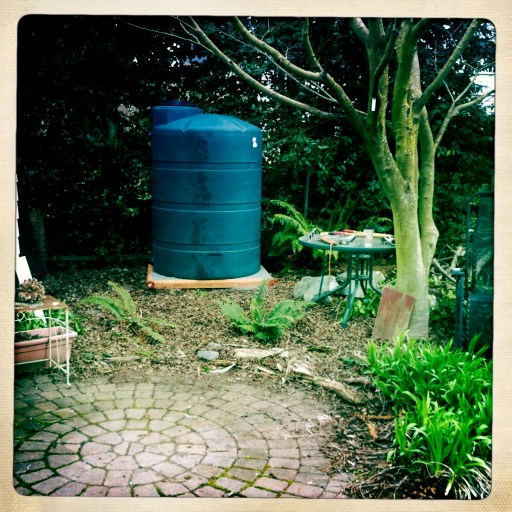
What I finally decided on was three 500-gallon cisterns; two collector tanks placed at downspouts by the house, and one as a ‘head’ storage tank located at the top of the property by the main garden.  The plan is to fill the head tank from the collector tanks, transferring water as-needed by portable solar/electric sump pump or pedal power (suggestions welcome).

The cisterns will be full all winter, then dip down past zero by August.  It looks like I will ultimately need more head tanks or to route more gutters to the collection tanks to tide us through the summer, but it is a start. By building more ollas for irrigation I hope for some water savings that will make this stored water go even further!
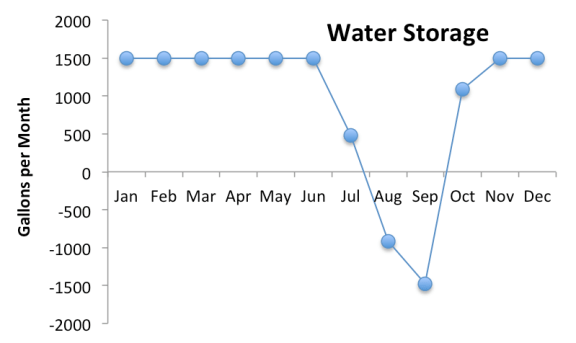
Clearly 1500 gallons won't meet all of our watering needs, but it is a start.

Next Post: Installing the cisterns!

UPDATE: 2012 Cistern Report

Posted in DIY, olla irrigation, rain, Sustainability, vegetable garden | Tagged , | 3 Comments

Olla Report 2011

2011 was a poor garden year for me.  A new job (busy!) and the weather sucked (cold, wet).

My tender young starts did not thrive. Twice the average rain in May, with very cool days, meant gardens throughout the Pacific Northwest were delayed an entire month.

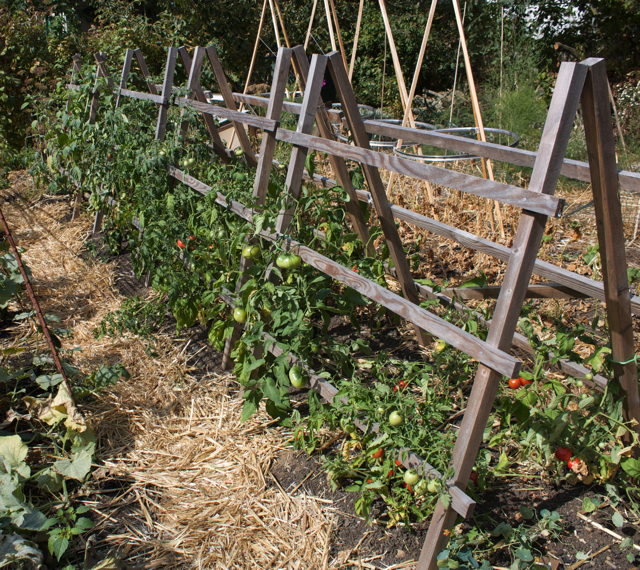
Tomato plants barely knee high by mid-July after the cold wet 2011 spring

In this, my second year of watering with ollas (2011), I planted the ollas among nightshades; tomatoes, peppers, eggplants.

When summer finally began, it rained once in July, once in August, twice in September.  It is common for July to be rainless, but such little rain over the entire summer was ‘special’.  Despite the excessive drought, the ollas clearly worked to provide water to the roots during the growing period (Jul-Sep).

Although the plants never got large, they did produce fruit into November.  I cannot make any scientific statements about the olla contribution during 2011, except to say that nightshades require a decent amount of water and overhead watering easily spreads soil diseases to vulnerable leaves.  Despite no hand watering in 2011, my nightshades produced well and were less diseased than usual by summer’s end.

Tomato plants in September were small, but produced well.

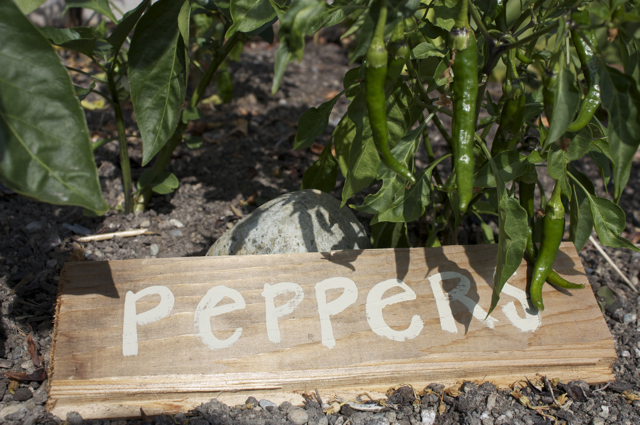
Peppers were prolific into November!

I am making more ollas this winter.  I hope that in 2012 I will be able to use ollas for all my deep-rooted, water-loving plants.  And I hope for a warmer spring (she says as it snows and snows outside).  Keep ‘ya posted.


Posted in olla irrigation, spring, tomatoes, vegetable garden, vegetable starts | 6 Comments

Homemade Gravity Chicken Feeder

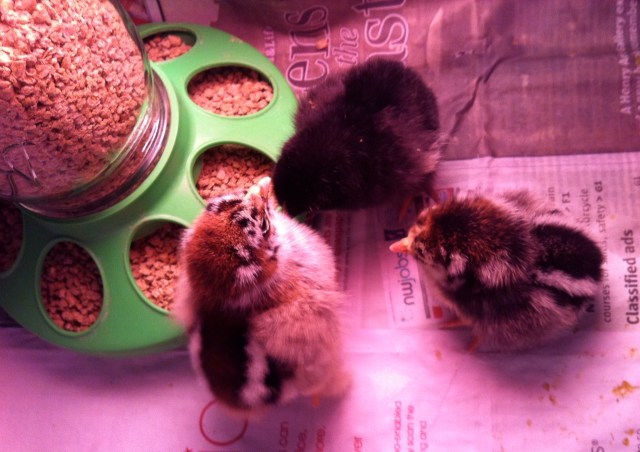
Mason jar chicken feeder; Calamity Jane, Blanca, and Roo, Spring 2011

We have always used a gravity feeder for our chickens.  For chicks we use the mason jar feeder (above).  This works great, but only for a couple of months.  By then the chickens eat enough that it must be refilled every other day, plus it is easy for them to knock over.

Inexpensive, this system works OK for just a few hens

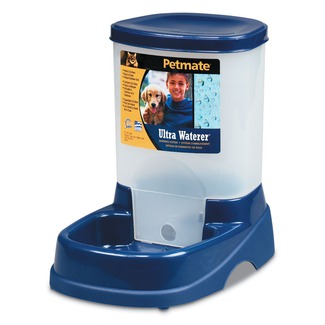
Next I purchased a gravity cat/dog feeder from the pet store. That worked pretty well until we increased our flock from 3 to 6 chickens.  We were having to refill it every few days and access became a problem for the lower-rung hens.

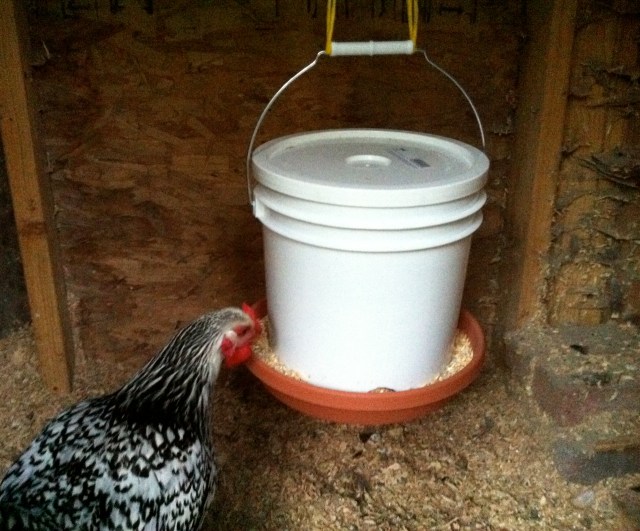
There are bigger, poultry-specific gravity feeders for purchase, but I knew I could build my own for a fraction of the cost. And I finally did. Our coop is small so I used a 2-gallon bucket instead of the 5-gallon bucket many designers use. I used a jig saw to cut four openings at the base of the bucket, and screwed the bucket to a plastic planter saucer, using washers on the bottom bolts to help distribute the weight.

Blanca, The White Queen, feeding at Version 1.0

Version 1.0 worked okay. As you can see in the photo above, the tray was a bit small – not a lot of room for a chicken to peck, and easy for her to spill food. The openings were also a bit small so that the food eventually blocked the hole, not automatically falling into the tray when the food level dropped.  This might not be an issue with pellets, but we use a layer mash containing Wheat, Barley, Rye, Peas, Lentils, Soy Meal, Flax Meal, Sunflower Meal, plus rock phosphate, calcium, etc, so powdery stuff tends to fills the spaces quickly.  When I found myself shaking the feeder daily to let more food into the tray, I knew I would have to do better.

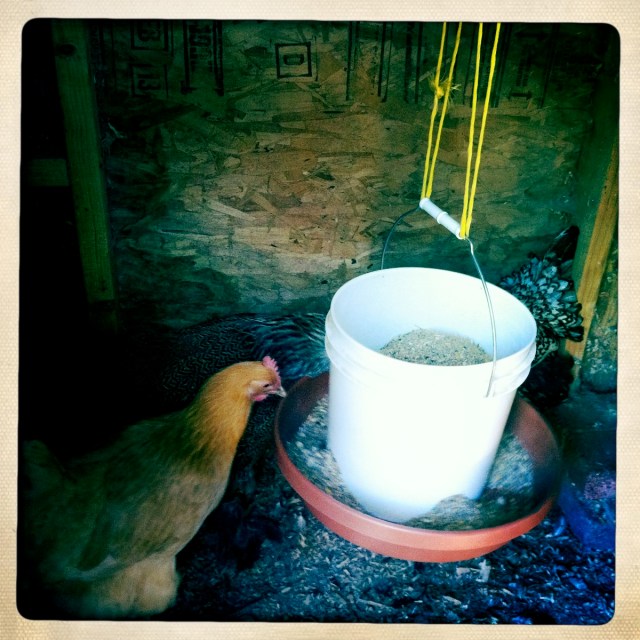
LaBuff, Calamity Jane, and Blanca feeding at Version 1.1 (lid temporarily removed)

Version 1.1 seems to be working better. I attached a larger tray and cut bigger holes in the bucket so that food can more easily spill into the tray when the level drops. There are no ergonomic issues for the hens, and it is hard for them to waste food by having it leap out as they bill and peck about.  As with many things chicken, this feeder may require further improvements.

Next up: Automatic waterer!

Posted in chickens, DIY | Tagged , | 2 Comments

The Warm Fuzzy of Insulation

Last month we got a letter from our electric utility.  We are at the “100% percentile for electricity use among neighbours with houses similar to ours”. That’s the bad end of the spectrum. Of course, we don’t have any neighbours with houses similar to ours – 800 sq.ft, work from home, all electric. Still – it doesn’t make us feel the warm fuzzy.

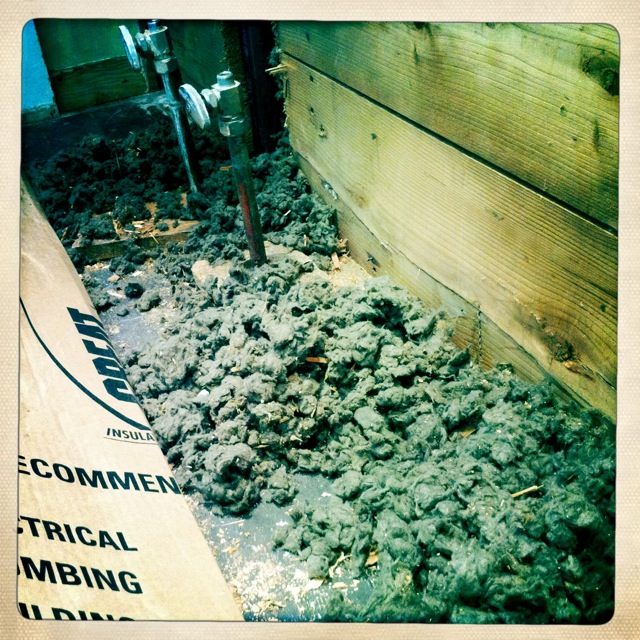
And yes, ‘warm fuzzy’ – this is about insulation. Our house is old. After our first big electric bill, a guy came from the City to help us with an energy audit. He pointed his infra-red gun at our walls and told us we had no insulation. When they came to blow insulation into the ’empty’ walls, they discovered a loose matrix of wool insulation – preventing them from simply popping holes in the outside wall and blowing in new stuff. Strike one.

The rather icky old wool insulation loosely filling our walls.

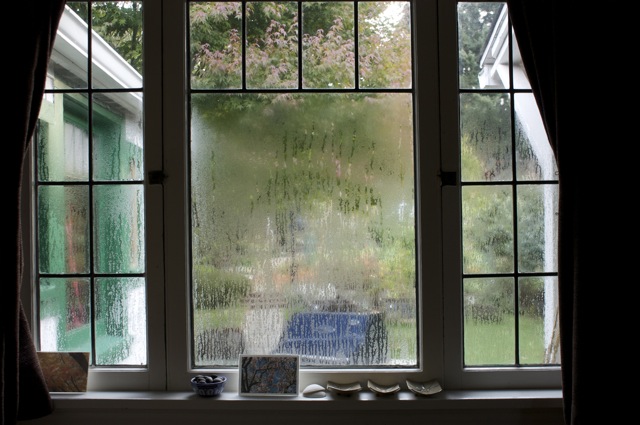
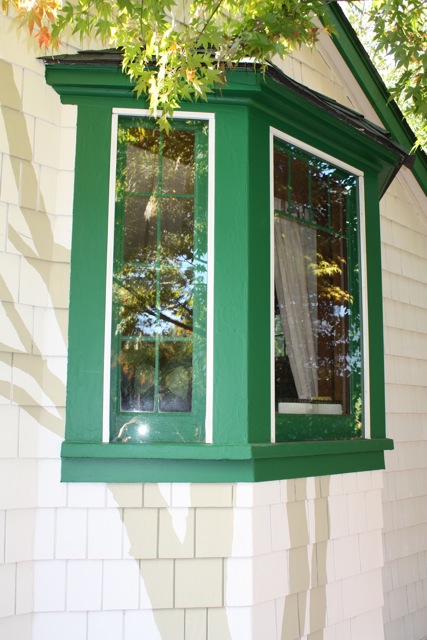
Strike two: our windows are all single-panel, original leaded glass. They are very ‘quaint’. And very inefficient.  There are brackets on the window frames where storm windows once hung. Unfortunately, we could not afford to have new ones made. We knew we needed to do something, so we decided on custom-cut acrylic panels.

Single-pane glass weeping condensation on a cold autumn morning.

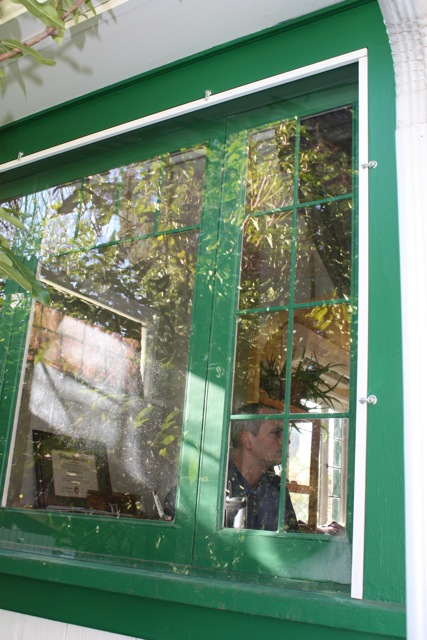
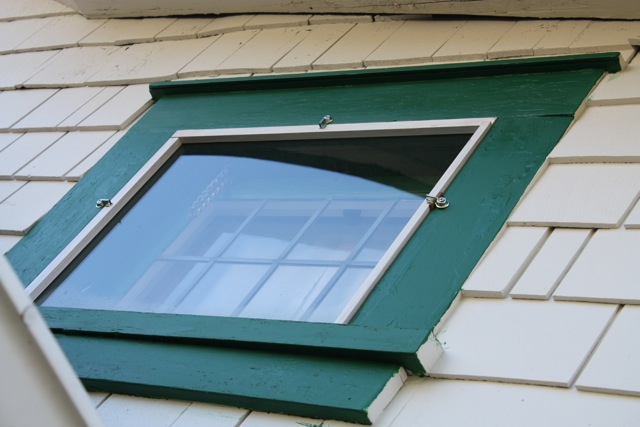
Improvised acrylic storm windows held in with wood trim.

The visibility was much better than I expected - from the inside we couldn't even see they were there!

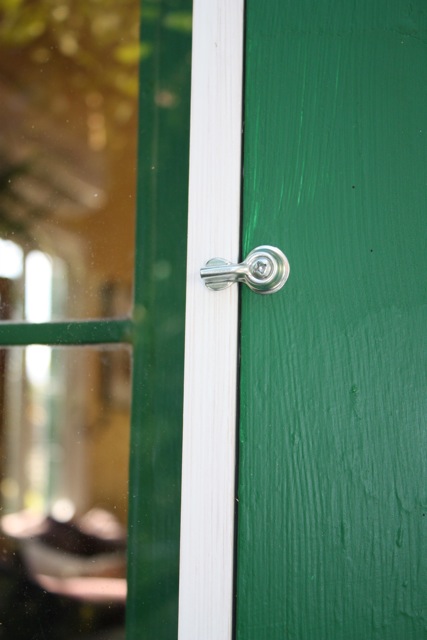
For the few windows that open in summer, we used single butterfly brackets.


Are they working? Yes. and no. No more condensation on the windows. And it is much quieter inside the house. So it greatly reduces the transfer of energy through the windows. However, our electric bill did not go down appreciably. But that is another story…

Posted in DIY, energy, Sustainability, winter | Tagged , , , , | 1 Comment