Chicken Food Fence Update

The Beta version of the chicken food fence was up by August, but the crops sown in September did not fare well. First, the chickens watched me sow the seeds. Which means they knew something good was going on inside that chicken wire. Where the wire did not reach the ground the hens were able to scratch and to dig with their beaks until the seeds came spilling out into their eager little mouths.

Some seeds survived and germinated. However, chicken wire is not very rigid. Even pulling it taut as we stapled there were places where the fencing dipped and buckled inward. In those places the fence was even less than the nominal 6″ allowed by the posts. Add the 1″ of beak from both directions that the hens can reach into the fence and very few of the brave buckwheat seedlings survived.

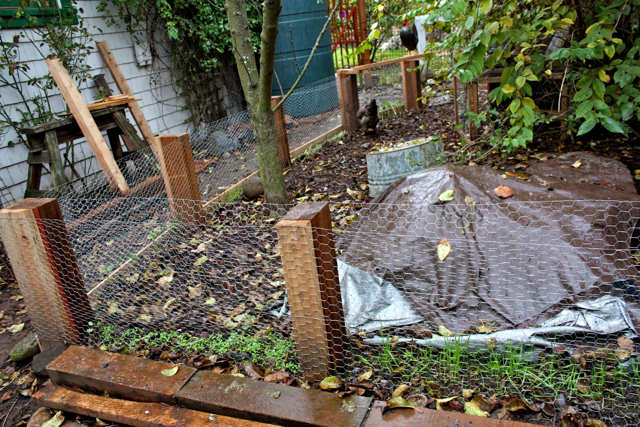
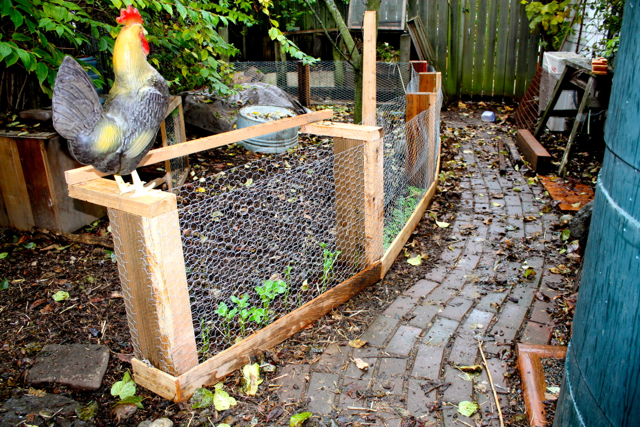
In October I added a 2×4 to each 4×6 post, increasing the nominal fence depth to 8″. I also bordered the bottom of each fence section with a cedar 1×4 to prevent digging. I then resowed the fence; this time with fava beans, crimson clover, and winter oats.

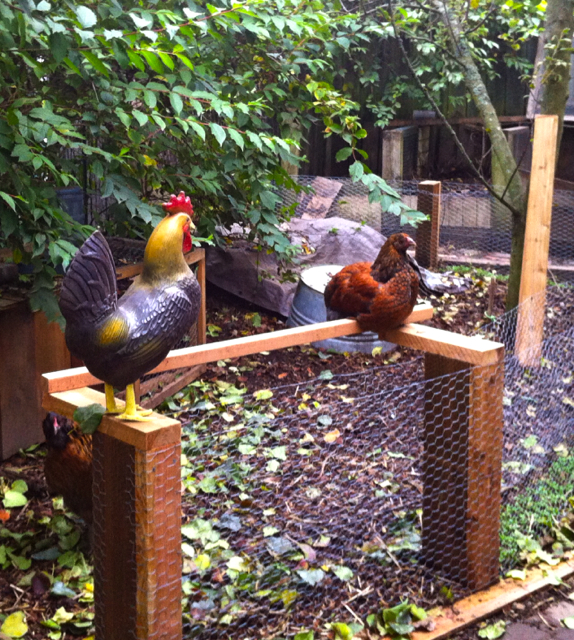
Food fence with chicken roost


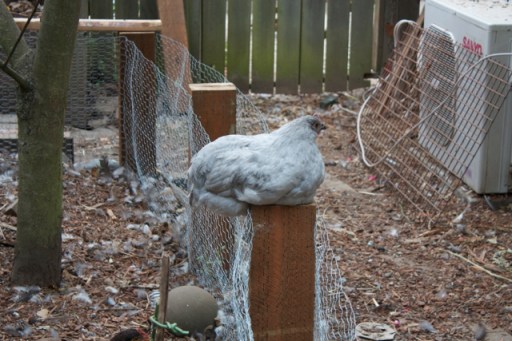
Finally, I have added one roost. My original thought was a roost centered over the fence. Further thought revealed that such a roost would result in copious poopage falling onto the plants inside the fence. Not good. So I measured a poopline out from the fence edge and built the roost there. So far only one hen uses the roost – Little Sister, bless her lonely heart.
Little Sister roosting on the chicken food fence

Little Sister roosting on the chicken food fence

With the colder weather of autumn it is slow growing. Although they seeds germinated, I doubt I will see the lush growth of my dream fence until March. And that is assuming the slugs don’t mow them down before then! Meanwhile I pick fallen leaves off the still-tender seedlings and scheme for further improvements…

Chicken yard with food fence

Posted in DIY, food fence, starting seeds, update | Tagged , , | Leave a comment

Homemade deodorant!

My friend and soul sister Erin is an inspiring scientist, educator, and renaissance woman. Erin taught me to make soap. For those of us with the I-want-to-learn-make-do affliction, that about says it all. When she told me about her homemade deodorant this summer, I immediately wanted to try it. So I asked her if she would write a guest post. Graciously she accepted and now I get to try making my own!

————————————————————————————–

I’m a huge fan of all Jen’s crafty, homesteady ideas so I’m excited to be writing a guest post for her blog!

I’ve been making my own deodorant for a few months now and it’s great! You get to pick from a huge array of scents and you avoid putting any weird chemicals on your body – what’s not to love? Plus, I find it works better than the previous brand I was using for odor control. And it only takes about 5 min! The recipe I use is modified from one I read on another blog and unfortunately I can’t remember the name of the blog so can’t give that person the credit she is due.

You will need:

  • Coconut oil
  • Baking soda
  • Arrowroot starch or cornstarch
  • Essential oils (optional)
  • Shea butter (optional)
  • Alum (optional)
  • Container to hold your deodorant

The coconut oil acts as a microbicide and fungicide, the baking soda helps absorb odor and the arrowroot starch absorbs moisture. If you can’t find arrowroot starch you can substitute cornstarch. Some sources suggest that using cornstarch can result in an increased chance of a yeast infection in your armpit; however, I couldn’t find anything definitive about that. Personally, I like the texture of the arrowroot better. It’s a bit more expensive but since you use such a small amount at a time it is still cost effective.

Step 1. Measure out equal parts by volume coconut oil, baking soda and arrowroot starch. I generally use 2T as my unit (i.e. 2T coconut oil, 2T baking soda, 2T arrowroot) since that amount fits well in my container and will last for several weeks.
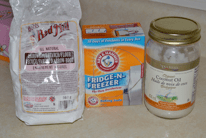
Basic Ingredients for Deodorant

Basic Ingredients for Deodorant

If you make up your first batch and find that it is too drying or makes your armpits itch, try reducing the amount of baking soda. I do this with mine – I actually just eyeball slightly less baking soda and slightly more arrowroot (not very scientific, I know).

Step 2. Add optional ingredients. I typically add about ¼ tsp of shea butter to my deodorant. Shea butter is a great moisturizer and soothes irritated skin. You can also add a few drops of essential oils to scent your deodorant if desired. For my 2T-based volume, I add about 6 drops of essential oil. I like to use 1 drop of tea tree oil, which is also a natural microbicide, along with 5 drops of some other more pleasant scent.
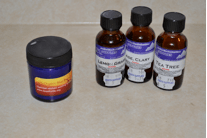
Optional Ingredients for Deodorant

Optional Ingredients for Deodorant

If you want your deodorant to function more as an antiperspirant you can try adding some alum. Alum typically comes in the form of potassium alum (KAl(SO4)2) and is commonly used in commercial antiperspirants (on the other hand, you may be making your own deodorant to specifically avoid use of aluminum products). I haven’t tried adding alum so I don’t have a formula for how much to use but if you do add alum, reduce the amount of the other powders you add in step 1. Alum is typically available in the spice section at the grocery store or at craft stores (it’s also used as a mordant for dying).

Step 3. Place your ingredients in a vessel that can go on the stove at a very low heat.
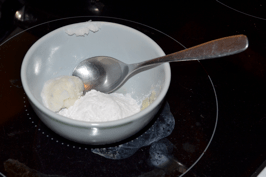
Ingredients ready for heating

Step 4. The melting point of coconut oil is only 76°F (24°C) so gently heat your ingredients until the oil melts. Mix the powder into the oil until you get a nice slurry consistency (note that hydrogenated coconut oil melts at a higher temperature – ~97°F/36°C so be sure to purchase unhydrogenated or virgin coconut oil).
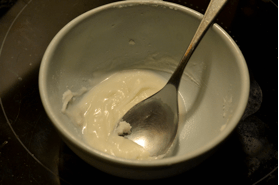
Remove from heat once melted

Remove from heat once melted

Step 5. Fill your container with the slurry and let cool until it resolidifies.
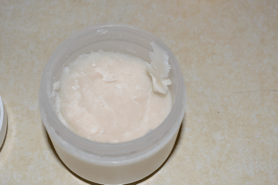
Pour into jar and allow to solidify

Pour into jar and allow to solidify

And that’s it!

To use, scoop a pea-sized amount and hold against your armpit until it melts into your skin. I find that in the winter I sometimes have to chip a piece off since the solidified coconut oil can be quite hard, and in the summer I sometimes have to place the deodorant in the fridge so it doesn’t melt completely.
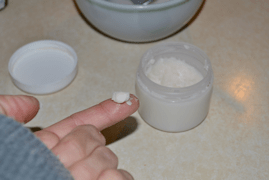
Homemade deodorant ready to use

Homemade deodorant ready to use

————————————————————————————–
Erin lives with her husband in Nanaimo, BC on beautiful Vancouver Island where she is a scientist for Canada’s Department of Fisheries and Oceans. In her spare time she rides horses, climbs, kayaks, knits, dreams of chickens, and plans her garden.

Posted in DIY, Health, homemade, personal care product | Tagged , | 4 Comments

Garden Soil Assessment

Every year I do the bare minimum to maintain soil fertility in my garden. I always make a big effort the first year I garden new land, resulting in amazing productivity, then find declining yields thereafter.

This is because I am a skimper. I have come to see that skimping is a pervasive trait of mine. I underestimate in all aspects of my life; ‘oh, that is enough allotted time, money, wood, fabric, food, compost, fertilizer, seeds, what-have-you’. It is very rarely enough.  They say it’s a Scottish thing (aka frugal, but aka cheap).

My garden yields this year were poor. I couldn’t even get my garlic to grow! And so, to be generous (something I am working on) with myself and the land that I care for, it is time that I work on building my soil. I used my new soil test kit (only one step up from my previous kit) to see what major elements might be out of sync. Across various beds I found that pH was acceptable, but low (6.0), N = Trace-Low, P = High, K = High-V.

Great. I need to add N and raise pH. I can do that! But what else? I wanted to know if maybe my soil composition was inferior. I totally geeked out on this very simple test:

Result of the soil 'Shake Test'

Shaken, Not Stirred

Identifying Soil Texture by Measurement

  1. From 6″ down, take soil from several places in your garden to form a composite sample
  2. Spread soil on a newspaper to dry. Remove all rocks, trash, roots, etc. Crush lumps and clods.
  3. Finely pulverize the soil.
  4. Fill a tall, slender jar (like a quart canning jar) 1/4 full of soil.
  5. Add water until the just is 3/4 full
  6. Add a teaspoon of non-foaming dishwasher detergent.
  7. Put on a tight fitting lid and shake hard for 10 to 15 minutes. This shaking breaks apart the soil aggregates and separates the soil into individual mineral particles.
  8. Set the jar where it will not be disturbed for 2-3 days.
  9. Soil particles will settle out according to size. After 1 minute, mark on the jar the depth of the sand.
  10. After 2 hours, mark on the jar the depth of the silt.
  11. When the water clears mark on the jar the clay level. This typically takes 1 to 3 days, but some soils may take weeks.
  12. Estimate the % of sand, silt, and clay.

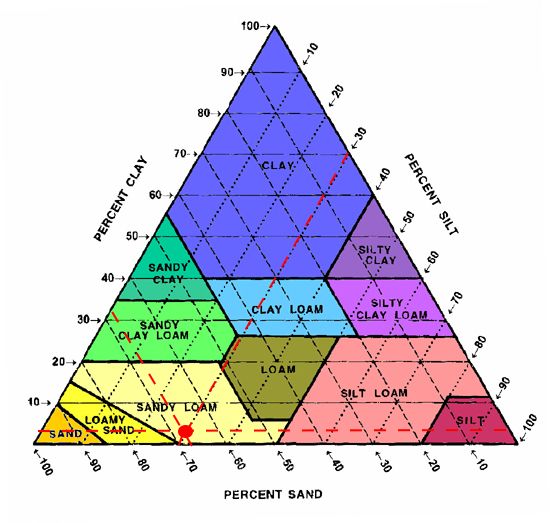
Next, find your soil type on the triangle plot:

Soil Composition Triangle

Soil Composition Triangle

So my soil type is ‘Sandy Loam’.  Ideal, many garden books would say.  The sand allows good drainage so roots do not rot in saturated soil, and the silt and clay hold moisture and ions that the plants need to grow. I don’t know what it means that my clay content is so low, but I am sure compost can fix most garden problems!

Here are my plans: wood ash to raise pH, animal poop to raise N, and another round of ‘cure-all’ compost

We have been burning a lot of wood this fall (yet to turn on our electric heat) and I was just wondering what to do with my ashes.  I was thinking soap, but the low pH got me thinking about soil amendments!  My garden book says sandy soils require 3-4#/100 sqft, while loam soils require 8#/100 sqft to raise pH by one unit.  I will aim for a 0.5 increase in pH units.  My beds are approximately 50 sqft each, so I will feed my sandy loam soils 2#/bed.

Wood Ash for increasing pH

This 2-gallon bucket of wood ash weighs 5# – enough for 2 of my garden beds

My only concern about the wood ash is raising K further.  I have read that excess K can cause Mg and P deficiency.  Que hacer?

Posted in geek, soil test, Sustainability, vegetable garden | Tagged , , , , | 4 Comments

The Last Roo Standing

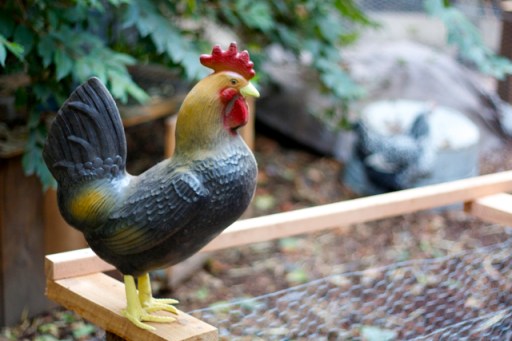
Plastic rooster in chicken yard

The new Roo in town

The only rooster left in our chicken yard is made of plastic. Although not dynamic (except when he falls over in the wind), there won’t be any crowing to wake our neighbours, and we have two less mouths to feed.

George the Gentle Giant Lavender Orpington

George the Gentle Giant Lavender Orpington

Last week as the chickens crowded around the snack I brought out, it finally occurred to me: this is too many chickens. Roo roo was destroying the garden with his daily escape-ades, George (originally ‘L’) just sat around placidly eating and growing, and the seven hens fought with them (and each other) over everything from sunny spaces to sleeping roosts.

Rooroo, the bug catcher

Rooroo, the bug catcher

I put a post on Craigslist advertizing our lovely roosters, replete with photos, highlighting their personalities and best features (Rooroo is a good bug catcher, George likes to be petted). I got several inquiries. Some began ‘Dear Sir, You have rooster? I come get. Zhou.’ Implied was the subtext: I happy to eat you rooster.

But I wanted them to go to a nice home, not the pot. I returned messages, leaving the Zhous and the Juans until last, but ended up calling even them. No one got back to me. Craigslisters can be flaky.

After the lack of serious inquiry, I got to thinking – I should eat them myself. I pulled out my homesteader manuals, reviewing the best methods for cleaning and butchering, then asked Scott if he would help me. Emphatically not interested. To be fair, we have butchered chickens before at my co-worker Tiffany’s urban farm. It was arduous and tedious. Understandably he felt satisfied with his experience.

Without enthusiasm from my partner, I wasn’t as interested in taking down the roosters, even with a friend’s help. It would be a lot of work for little gain. Better I find them a home or a pot elsewhere.

So I reposted an ad on Craigslist. This time I wasn’t so particular. And I just advertized Rooroo, thinking I would keep George the Gentle Giant as long as possible (he was SO pretty and I wanted to hear his crow). Zhou #2 definitely wanted to eat my cockerel. Fine. I left him a message.

Soon after, I heard from a Mrs. Rabbit who thought Rooroo was just beautiful. The Rabbits (hee hee) live on a farmlet outside of Seattle, have a large flock of hens, and were in need of some roos. Mr. Rabbit happened to be in town. I frantically called Scott – please – has an Asian man come by for Rooroo? No? Great! Mr. Rabbit and Scott packaged up both roosters for their new home.

George and Rooroo

Best buds: George and Rooroo

I sent Mrs. Rabbit an email directing her to my blog and hinting that I would love continued correspondence to hear how my roosters turn out, but nary a peep from her 😦  I miss George’s sedentary humour and Rooroo’s antics, but things are a bit more manageable and I was finally able to sow my winter cover crop.

Raising these chickens was a great experience, but letting them go can be hard. If we can’t get our hens to start laying again, we may have to get a whole new crop come spring…

Posted in baby chickens, chickens | Tagged , | 3 Comments