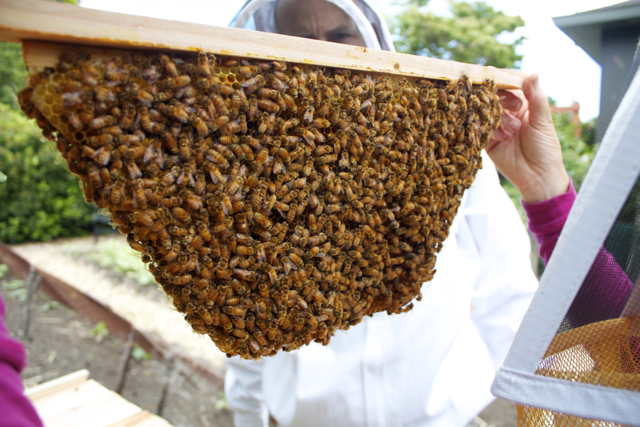
Inspecting a fully built brood comb
I look at the bees every day. I watch them fly about the yard, and I peek into the hive through the
observation windows. A few weeks ago we noticed the first drone bees. These are males (in contrast to the female queen and the female-neuter worker bees). The drones are big. Really big. With big eyes and big fat bodies. I was concerned that drones meant our hive was getting ready to swarm, but my TBH mentor tells me that a healthy hive has about 20% drones. Besides eating a lot of honey, drones make trips out of the hive to look for other queens to mate with. It’s the only way for the hive to spread their genetics.
Every 1-2 weeks we open up the hive to get a better look at what is going on. Sometimes we need to fix cross-combed bars – though only on our Carniolan hive. This is where a comb is built not parallel to the top bar guide. In our Carny hive, cross-combing is usually the result of a curved comb – it starts on one bar and ends on another. We try to pry the curved section off the second bar and bend it back in line with the original bar. Sometimes this is successful, but the whole hive is wavy in places. So far our Italian hive is producing beautifully straight, consistent combs.
Last week my parents were visiting, so we finally had a photographer to document our inspection. Scott starts the smoker with pine shavings from our chicken stash, we suit up (I in my veil, and Scott is his bee jacket), and with tools in hand (pry bar and brush), we begin.
I remove the lid, and gently pry up the last top bar in front of the follower board. Scott gives two puffs of smoke to the bee entrance and then two inside the hive where I have pried up the bar. I close the bar and we let the smoke settle. The smoke serves to block alarm pheromones, as well as dope the bees.
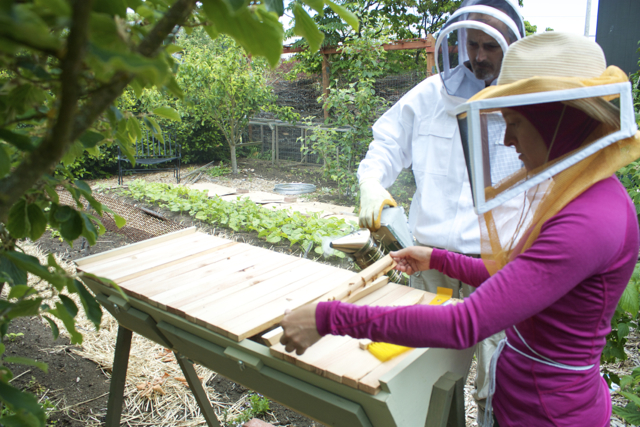
Smoking the hive just before the follower board
After a minute, we start the inspection. I try to keep 3-6 empty top bars at the back of the hive for expansion (in front of the follower board – which is the moveable back of the hive). These empty bars come out first, usually with one or two bees on them. After that, I pick up the first combed bar and take a look. The newest combs, works-in-progress, are at the back of the hive. These are white and delicate. We look to see if there are any eggs in the comb cells, and then place the bar against the follower board.
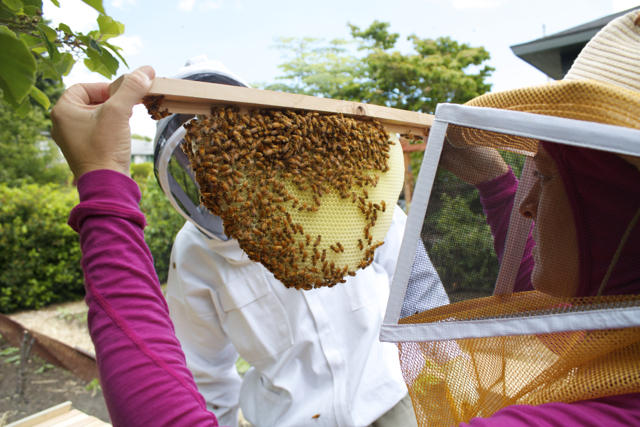
Young comb, still soft to the touch
As we work, this 3-6 bar opening moves with us towards the front of the hive. Comb yellows as it ages, becoming brown over a few weeks, and black over a few months. We are quickly into fully built out comb; brown, with capped brood, including many bubbled drone cells. Flat-capped brood holds worker bees, but the larger drones can only be accommodated by a bulged out cell in the comb structure.
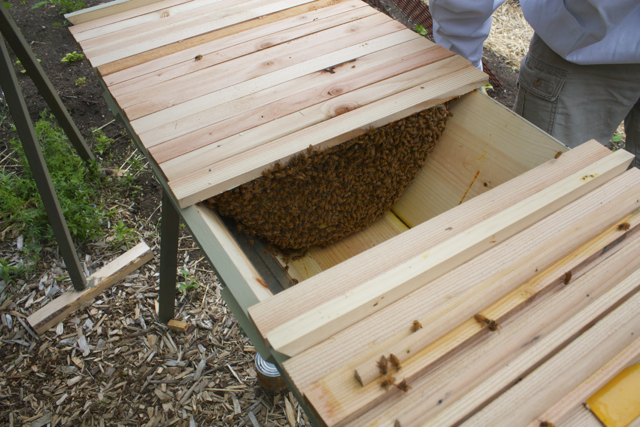
Inside the hive during inspection
Next we see comb with empty brood cells. I think the bees re-use these combs for more babies. We still do not see much honey. Brood combs tend to have brood covering most of the comb, with some honey and pollen cells around the edges, presumably to snack on. There is so much to know. Now that summer is really upon us (it has been unusually warm in the PNW), I am eager for another inspection to check out whether the bees are shifting their focus yet from brooding to honey production!
It has been a month since we have seen either queen, but the hive continues to expand, so she must be in there. We will try again soon.


 Sustainable Scientist