
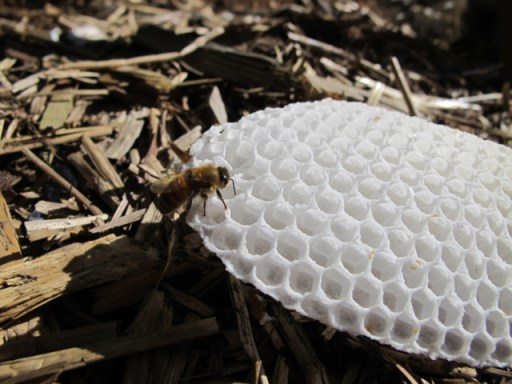
Italian honey bee on new piece of comb
Ready for the next challenge, we have taken on honey bees at our urban farmlet! Two classes from Seattle Tilth and one book later, I found myself building hives (just) in time for the arrival of our bees. The bees I’ll write about later. This post is to detail building top bar bee hives.
We first learned about top bar bee hives (TBH) from Erick McWayne at Soos Creek Farm. Another farmer friend, Dana Ecelberger, swears by the top bar hive as a more ‘natural’ approach to bee keeping. I liked what I read about TBHs compared to ‘conventional’ Langstroth hives. Stacked, rectangular Langstroth hives are designed to maximize honey production. As casual urban farmers, this wasn’t a priority for us. Sometimes called the ‘Kenyan’ top bar hive, this older alternative method appealed to us. Instead of providing foundation and frames within which the bees build their combs, the bees build their own combs down from a ‘top bar’. Some of the benefits of a top bar hive include:
- more honeycomb produced
- more control over honey quality – can process smaller batches
- don’t need an extractor to process honey
- the whole hive is horizontal – no need to bend and lift boxes
- bees have more control over comb production
- can watch hive evolve through observation window
- less disturbing to bees because you open only small part of the hive at a time
TBHs retail for ~$300. I was pretty sure I could make one for less. I looked at a lot of pictures and designs for hives online. I visited a neighbour to see how he built his hive. I decided I wanted an observation window, a side entrance, top bars with guides, and a screen floor. I loosely followed the plans in Les Crowder’s book, but modified them for desired features and, well, because I’m not that great a carpenter and had mistakes to fix!
Carpentry skills or no, I indulged in two new tools for this project. Why did I wait?! I love love love my new saw and router. Both Makita, the circular saw cuts like a dream (compared to the 20 lb vintage steel Craftsman of my uncle’s father that I had been fortunate to borrow for many years). The router – well, it’s my first (blush). I knew there was something important missing from my toolbox. This was it.
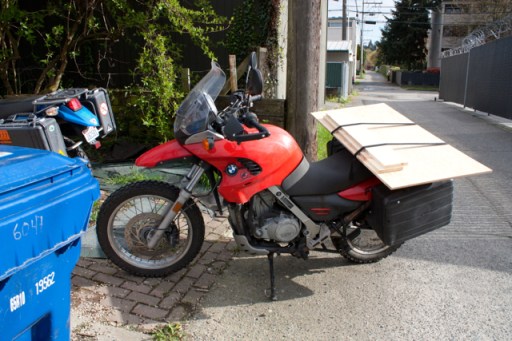
I felt pretty badass picking up supplies on my motorcycle when we loaned out the car
We bought three 8′ 1″ x 10″ pine boards for the hives. Side boards were cut to 44″ long. I aimed for 120-deg bottom angles for the walls, so cut the end boards 18 1/2″ on the top edge and 7 3/4″ on the bottom edge. The follower boards are the same size as the end boards. [A follower board constricts the hive – you move it further back in the hive as your population expands]. For the bottom, I tried to bevel the edges for a tight fit with the side boards. They’ll do, but I did make some math errors 😐 The screen floor didn’t come together in time, so the hives currently have solid floors.
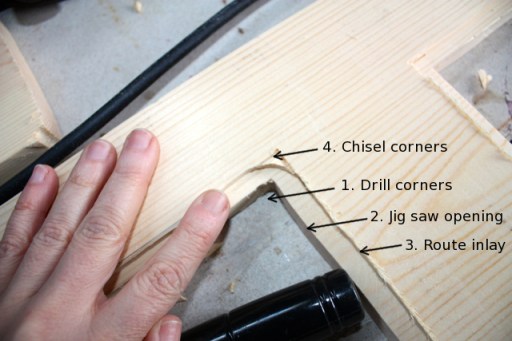
Inlaid observation windows (inside view)
Figuring out how to make observation windows was one of the most challenging aspects of this project. I ultimately re-used some pieces of acrylic and polycarbonate. Each sheet was not long enough for an entire window, so I ripped them in two (with a blade for plastic on my new saw) and made two windows per hive. After cutting and routing spaces for the windows to sit flush on the inside of the hive, I glued the windows in place.
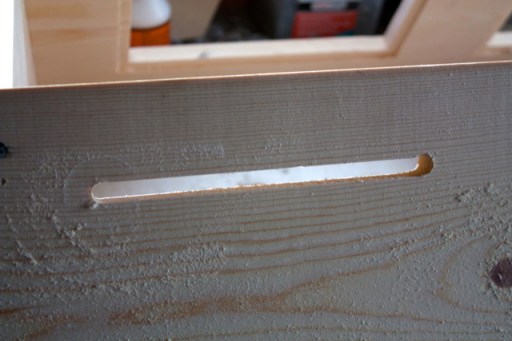
Bee entrance in the sidewall
On the first hive, I cut a 6″ wide opening for the bee door in the side panel – just below the window. I quickly realized that was not going to work – you can’t be bee-gazing right in the flight path of said bees. So I plugged that opening and routed another on the plain sidewall – opposite the observation windows. I attached a 7″ length of quarter round just below the bee entrance as a landing pad. I forgot to take a photo of that, so you can see it on the next bee post.
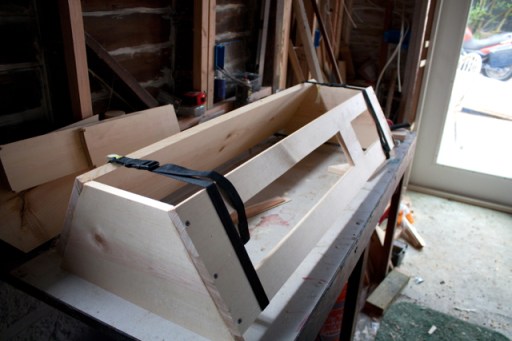
Rock straps hold the glued and screwed sides while drying
All the hive body joints were glued and screwed for strength. Cracks were filled with sawdust mixed with glue (I am proud I thought of that myself). I used my rock strap tie-downs from my motorcycle to hold the sides and ends together as the glue dried.
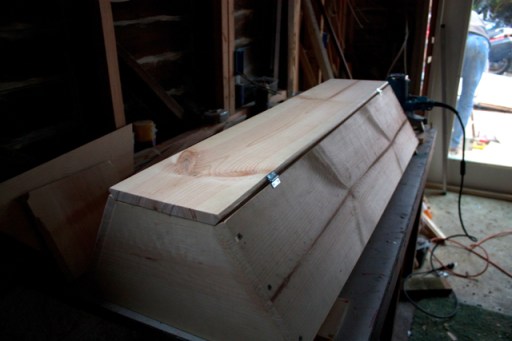
Hive bottom in place

Inside the hive with top bars upside down
The top bars are pine stakes (1 x 1 3/8″) purchased in packages of 12. I cut off the stake part for a length of 19″ – flush with the top sides. On the underside of each bar, I glued and nailed a 16″ piece of quarter-round molding – it is rounded on one side, but vertical on the other, with the vertical part along the midline of the bar. That will (hopefully) guide the bees to build their combs straight and parallel.
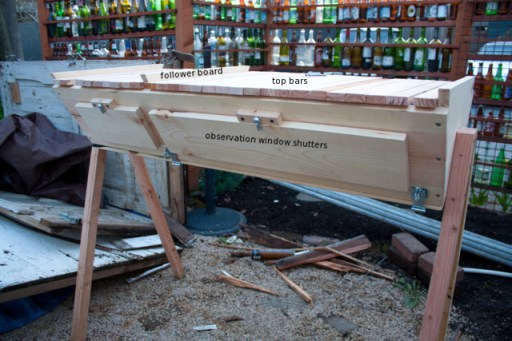
The finished hive (sans lid)
And that’s pretty much it. I cut some shutters to cover the observation windows, attached them with hinges and wing clasps. I painted the outside of the hive body and the legs, and threw the plywood cover on top. Then it started to rain and we left for Moab.
Project costs:
Pine hive lumber = $40
Pine stakes for top bars = $20
1/2″ quarter-round molding for bar cleats= ~$40
Screws = $6
Hinges for observation windows = $10
Temporary plywood lids = $30
I also used wood glue, scrap 2×2 for the legs, metal brads, and paint already on hand. Cost per hive was therefore about $80. Not bad.
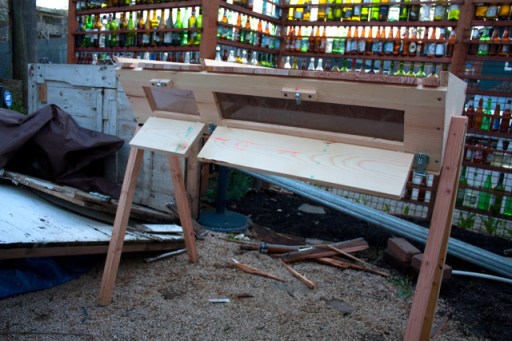
Observation windows open

Painting the hives
Next up: BEES!!!


 Sustainable Scientist
